
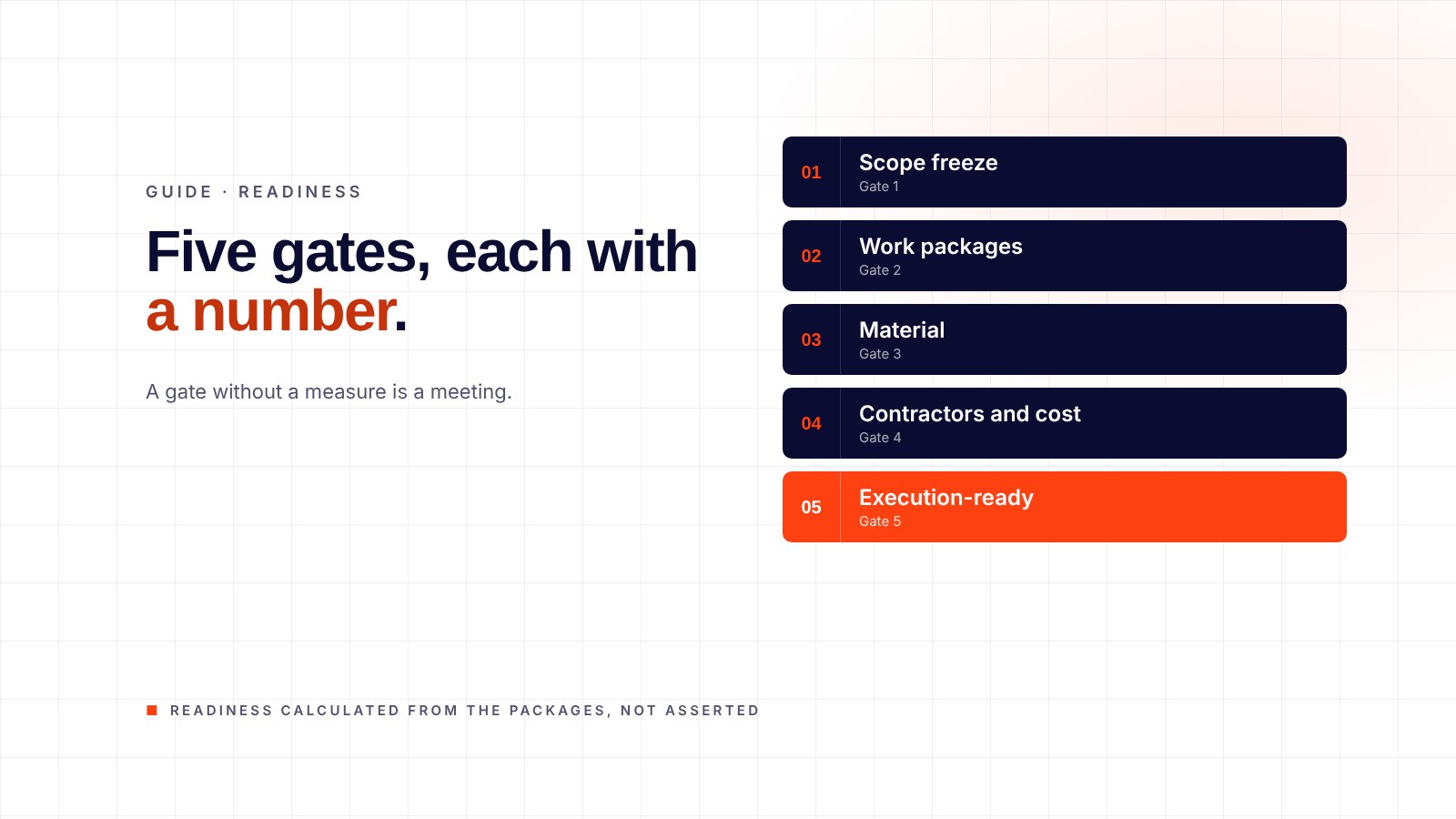
01Why gate reviews fail
Most readiness reviews assemble the picture by hand from four systems: milestones in one, scope in another, work packages in a third and material in a fourth. Compiling it takes about a week, so the review describes the past. The gate is declared complete because the people in the room say so, and nobody can check.
The fix is to make every item on the checklist measurable from the work itself. If readiness is calculated from the packages and the material, the review becomes a reading of the number, and the meeting is spent on the exceptions.
02Gate 1: scope freeze
| Item | Measure |
|---|---|
| Scope list complete and approved | Count of items, each with an owner and an approval date |
| Each scope item has a work package number | Items without a package: zero |
| Long-lead material identified per item | Items flagged long-lead, with the lead time in weeks |
| Change process agreed | The approver, the form and the cut-off for additions, written down |
| Scope added since the last review | Count, with hours and cost, visible the day each was added |
03Gate 2: work packages
| Item | Measure |
|---|---|
| Packages developed | Percentage of scope items with a complete package |
| Package reviewed by the executing contractor | Percentage reviewed and accepted |
| Steps, crew and duration defined | Packages missing any of the three: zero |
| Permits and isolations identified | Packages with permits listed: percentage |
| Drawings and procedures attached | Packages with documents: percentage |
| Package tied to a schedule activity | Packages with an activity date: percentage |
04Gate 3: material
| Item | Measure |
|---|---|
| Requisition raised per package | Packages with a requisition: percentage |
| Purchase order placed | Requisitions with a PO: percentage; days since requisition for the rest |
| Long-lead items on order | Long-lead items without a PO: zero |
| Material received | Line items received against ordered: percentage |
| Material staged per package | Packages fully staged: percentage |
| Shortages against activity date | Items whose promised date is later than the activity date: count |
05Gate 4: contractors and cost
| Item | Measure |
|---|---|
| Estimates submitted in one format | Packages with an estimate: percentage |
| Bids compared and awarded | Packages awarded: percentage |
| Budget built from approved estimates | Budget lines without an estimate: zero |
| Manpower plan by day | Planned headcount by contractor by day, loaded |
| Mobilization dates confirmed | Contractors with a confirmed date: percentage |
| Contractor access to the system | Contractor users set up and trained: count |
06Gate 5: execution-ready
| Item | Measure |
|---|---|
| Packages issued to the field | Percentage issued |
| Material issued to the job | Packages with material issued: percentage |
| Field capture tested | Progress, QA and discovery captured on a phone for one package, end to end |
| Close-out target set | Hours from work complete to package closed; target under 24 |
| Daily cost reporting live | Contractors reporting inside the system: count |
| Readiness percentage | One number, calculated from all of the above |
07Readiness as a percentage
A readiness number is only useful when it is calculated. Package completion shows as a percentage of packages with every required element. Material readiness shows as the share of packages fully staged, with shortages listed against the date they matter. Scope added after the freeze shows on the day it is added, with its hours. When those three exist, the gate review is ten minutes on the exceptions. A gate you cannot measure is just a meeting.
08How to run the review
Circulate the numbers the day before. The meeting reads them; it does not compile them.
Walk the exceptions only: packages without an element, items without a PO, scope added since the last gate.
Assign each exception an owner and a date in the room.
Do not declare the gate complete on a promise. A gate with open exceptions is open.
Record the gate's numbers. The next event's first review starts from them.
09How a gate gets declared complete when it is not
| What is said in the room | What is usually true | The measure that would have caught it |
|---|---|---|
| "Packages are done" | Packages exist; a third are missing permits or drawings | Packages with every required element, as a percentage |
| "Material is 95% received" | Received at the dock; not staged by package | Packages fully staged, as a percentage |
| "Scope is frozen" | Frozen on paper; 40 items added since, none costed | Scope added since the last gate, with hours |
| "Contractors are ready" | Awarded; estimates still in three formats | Packages with an estimate in the standard format |
| "The field is ready" | Nobody has captured a package end to end on a phone | One package captured end to end, as a test |
10Using the checklist on the next event
The numbers recorded at each gate are the next event's baseline. Package completion at gate 2, the staging percentage at gate 3 and the scope added after the freeze become targets, and the next planning team starts from the packages, material lists and contractor estimates this event produced rather than from a blank list. A site that runs the same unit on a four-year cycle should see each gate reached earlier every cycle, and the readiness number at each review higher than the last time.
11Starting with the checklist mid-planning
Most sites first use a checklist like this one on an event that is already months into planning. That is fine. Run the five gates as a review of where the event stands today: load the scope list, count the packages with every element, count the packages fully staged, list the scope added since the freeze with its hours. The first numbers will be low and the exception lists long. That is the point; it is the same picture the team would have discovered in execution, found while there is still time to close the gaps. Run the review again every two weeks. By the execution-ready gate the numbers should be in the nineties and the exception list short enough to walk in ten minutes.
12Where EZTRAK fits
EZTRAK Pilot is turnaround planning and management software that calculates readiness from the work: package completion as a percentage, material readiness against the activity date, and scope added after the freeze visible the day it is entered, with its hours. Flow supplies the material measures from requisition to staging, and Vault supplies the estimates, budget and headcount plan. The gate review becomes a reading of the numbers.
13Frequently asked questions
How many gates should a turnaround have?
Five is a working minimum. Larger events add gates inside planning, but every gate needs a measure or it is a meeting.
What if the contractor keeps the packages in its own system?
Then the owner cannot measure gate 2 or gate 5. Contractors working inside the owner's system is the condition that makes the checklist possible.
Can readiness be measured on an event that is already planned?
Yes, and that is the usual case. Load the packages and material as they stand; the first number is low, and it climbs as the gaps close.
What is a good close-out target?
Under 24 hours from work complete to package closed. One site moved from over 72 hours to under 24 by capturing completion in the field with QA notified at once.
See readiness calculated, not asserted.
Fifteen minutes: packages, material and scope changes rolled into a gate number you can read before the meeting. Or call 626-327-6348.