
01Why the number is always late
A turnaround spends in days what a plant spends in months, and it spends it through contractors. A 21-day event with 50 or more contractors produces more than 1,000 contractor-day cost reports. When those reports arrive in 50 formats, someone rebuilds them by hand before a cost engineer can add them up. By the time the total exists, the decisions it should have informed have been made.
The same problem starts earlier. Contractor quotes arrive in each contractor's format, so comparing them means re-keying them into one sheet. Costs from the last event were captured the same way, so they cannot be benchmarked against this one. Nothing is comparable because nothing was captured the same way.
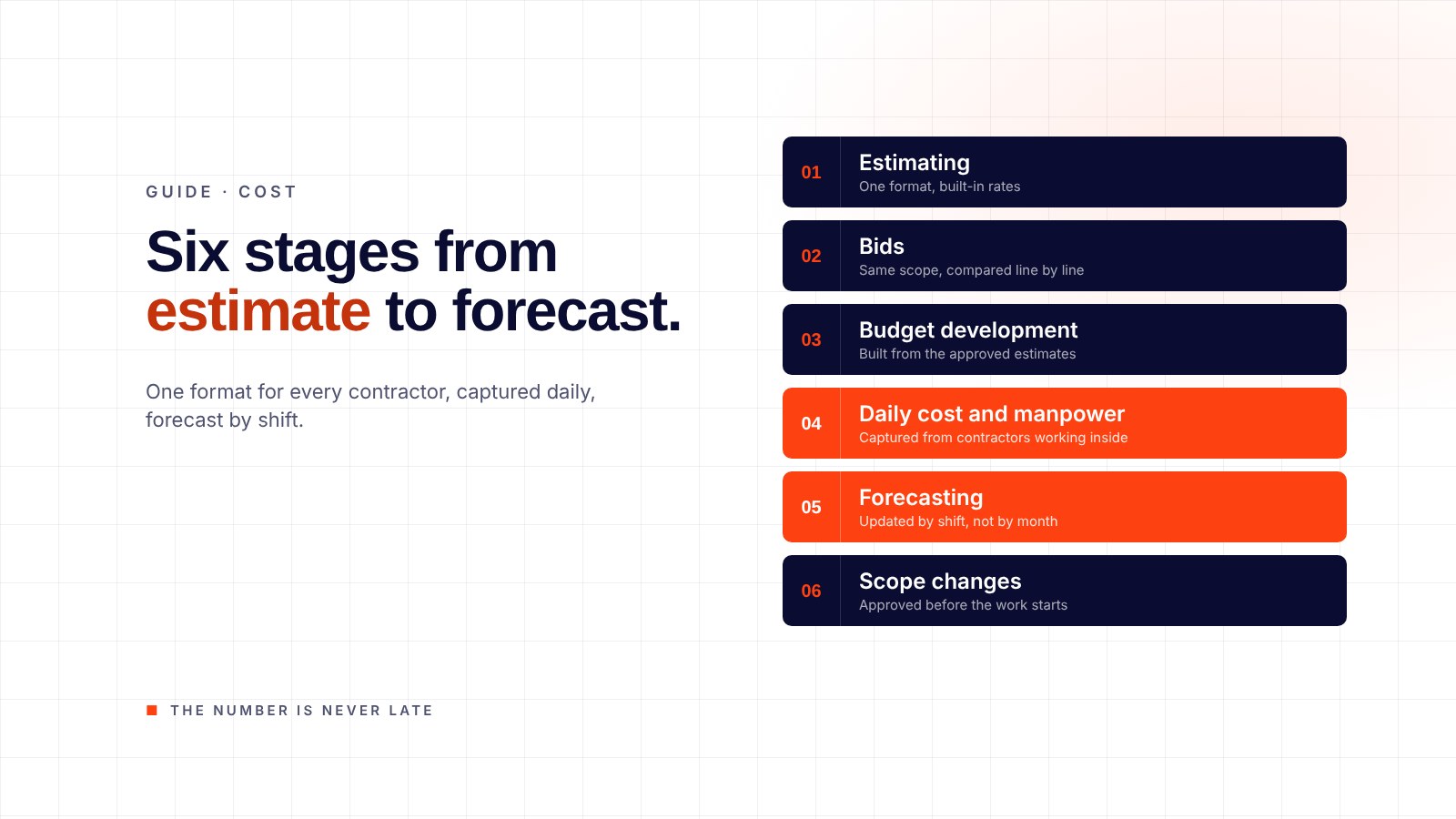
02The six stages
| Stage | What happens | The control |
|---|---|---|
| 1. Estimating | Contractors estimate each work package | One format, with built-in rates, for every contractor |
| 2. Bids | Contractors price the scope | Same scope, same format, compared line by line |
| 3. Budget development | The approved estimates become the cost and manpower budget | The budget is built from the estimates, not beside them |
| 4. Daily cost and manpower | Estimated cost, incurred cost and ERP actuals; headcount plan against actual by day | Captured daily, from contractors working inside the system |
| 5. Forecasting | Incurred cost compared with the budget, forecast at completion | Updated by shift, not by month |
| 6. Scope changes | Work added after the freeze | Approved before the work starts, with its hours and cost |
03Stage 1 and 2: one format for estimates and bids
The control that fixes most of what follows is the simplest: contractors estimate and bid inside the owner's system, in one format, with the owner's rates built in. Two things happen. Quotes become comparable line by line, which makes bidding more competitive. And the estimate becomes the first version of the budget rather than a document that is re-typed into one.
On a $25 million turnaround, a 1% improvement in pricing is $250,000. That is the value of comparability alone, before anything is tracked.
04Stage 3: build the budget from approved estimates
A budget assembled separately from the estimates drifts from them before the event starts. Build the cost and manpower budget directly from the approved estimates, by package, so every budget line traces to an estimate and a contractor. Then the daily comparison in stage 4 has something to compare against.
05Stage 4: daily cost and manpower
Three numbers per package per day: the estimated cost, the incurred cost from the contractor's daily report, and the ERP actuals once they post. Beside them, the daily headcount: planned against actual, by contractor, by day. Headcount is the earliest warning on a turnaround. A contractor running 20% over plan on headcount for three days is a cost overrun that has not been invoiced yet.
The control is where the numbers are captured. When contractors enter their daily cost report inside the owner's system, the format problem disappears and the total exists at the end of the shift.
06Stage 5: a forecast that moves by shift
A forecast at completion is only useful while there is still time to act on it. Compare incurred cost against the original budget every day, carry the trend forward, and show the variance by package and by contractor. Leadership should be able to answer "what is this going to cost" at the start of any shift, not at the monthly review.
07Stage 6: scope changes approved before the work
Discovery work is normal on a turnaround. Uncontrolled discovery work is not. Every scope item added after the freeze should be visible the day it is added, with its hours and cost, and approved before a crew is assigned. The forecast then moves the same day. Scope that shows up for the first time on an invoice is the single largest source of overrun on most events.
08What comparability buys you next time
When every event is captured the same way, the second event can be benchmarked against the first: cost per package type, contractor performance against estimate, headcount curves by phase. That is the turnaround cost comparability most sites say they want and few have the data for.
09A $25 million event in numbers
| Measure | Typical figure | What the control does with it |
|---|---|---|
| Work packages | 400 | One estimate line per package, in one format |
| Contractors | 50 | 50 daily cost reports in one format, not 50 formats |
| Contractor-day cost reports, 21 days | 1,000 or more | Entered inside the system at the end of each shift |
| Material share of spend | 30 to 40% | Tracked from requisition to installation, reconciled daily against ERP actuals |
| Scope added after the freeze | 5 to 15% of hours | Approved before work starts; in the forecast the same day |
| Value of a 1% pricing improvement | $250,000 | Line-by-line bid comparison |
| Headcount variance that signals an overrun | 20% over plan for three days | Visible on day three, not on the invoice |
10Common mistakes
Building the budget in a spreadsheet beside the estimates, so the two drift apart before the event starts.
Accepting contractor daily reports in the contractor's format and rebuilding them by hand, which turns a daily number into a weekly one.
Reporting cost by calendar month on an event that lasts three weeks. The forecast has to move by shift.
Treating discovery work as inevitable and therefore uncontrolled. It is inevitable; its approval is not.
Capturing this event's cost in a way that cannot be compared with the last one, so there is still no benchmark next time.
11What to do before the next event
Three changes, in order. First, write the standard estimate format into the next bid package, so every contractor who bids has already used it. Second, build the budget from the approved estimates by package, not beside them, so stage 4 has a line to compare against. Third, decide the day the event starts that cost will be reported by shift, and give contractors the place to report it. None of the three needs the turnaround to be large; a $5 million event with eight contractors has the same six stages and the same reasons the number is late. The difference at the end is a forecast that was true at the start of every shift, and a cost history the next event can be measured against.
12Where EZTRAK fits
EZTRAK Vault is turnaround cost tracking software that covers all six stages: estimating and bids in one standard format, budget development from approved estimates, daily cost and forecasting against ERP actuals, vendor cost tracking, forecast and change control, and daily headcount plan versus actual. Contractors work inside it. One site consolidated more than 20 spreadsheets and paper forms into EZTRAK; the PBF Torrance case study has the detail. The Turnaround ROI Calculator estimates what the same controls would save on your next event.
13Frequently asked questions
Does this replace SAP for cost?
No. SAP stays the system of record for purchasing and finance. EZTRAK reads actuals from it; data can be written back or transferred manually.
How do contractors get access?
Time-limited, role-based access to their own packages and reports. They see their scope, not the event.
What if a contractor refuses to use our format?
Make it a condition of award. The format is built into the bid, so a contractor who bids has already used it.
How current can the forecast be?
As current as the last daily cost report. On sites where contractors report inside the system, that is the end of the previous shift.
See Vault from estimate to forecast.
Fifteen minutes: one estimate format, bids line by line, daily cost and a forecast that moves by shift. Or call 626-327-6348.