
A gate you can't measure is just a meeting.
Most turnaround organizations run front-end loading phases, gate reviews and scope freeze dates. Then someone says the final gate is complete, and the room moves on.
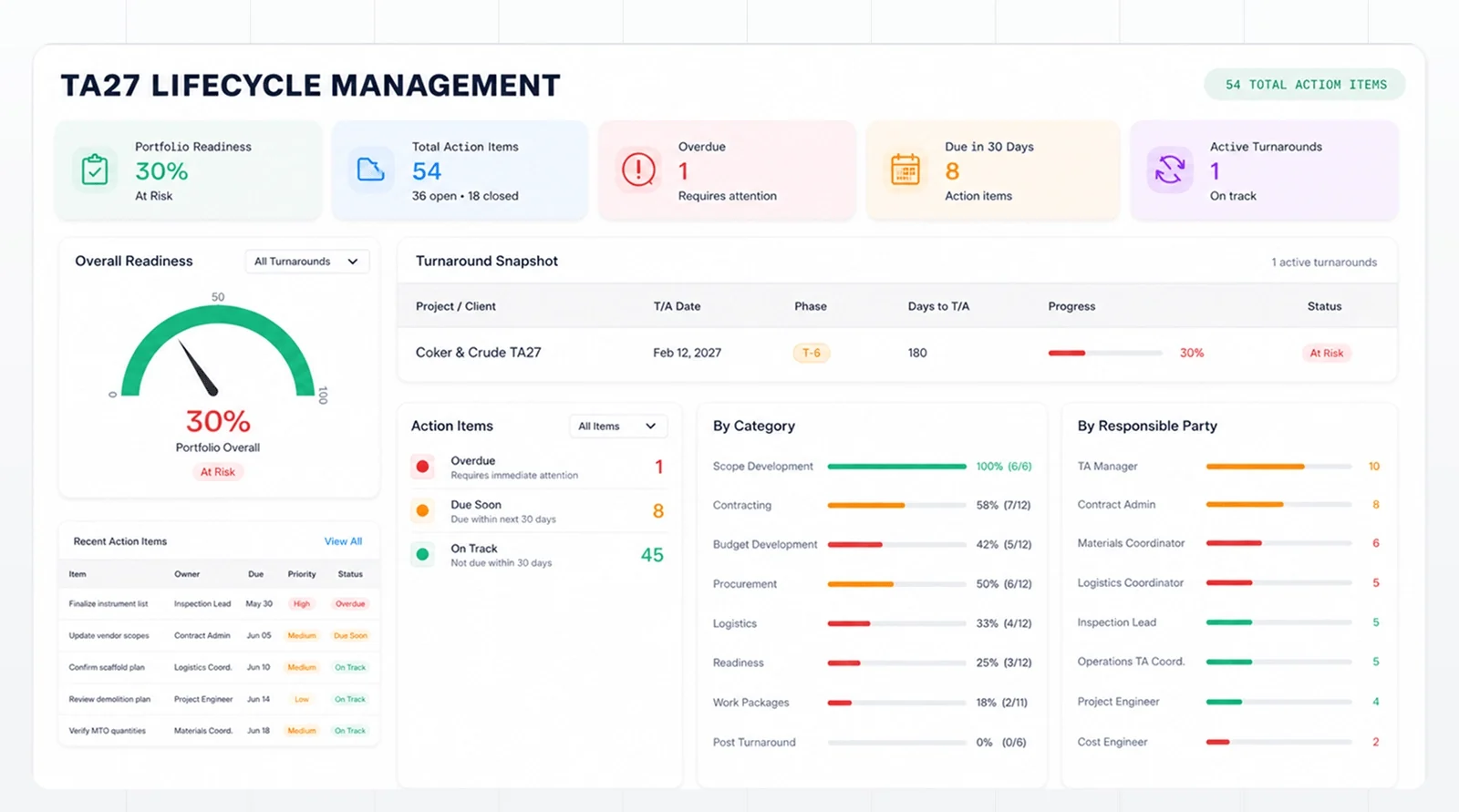
Readiness by category and by responsible party, with overdue items surfaced — calculated from the work rather than assembled for a meeting.
Most turnaround organizations use front-end loading (FEL) phases, gate reviews, scope freeze dates and milestone charts.
And then someone says the final FEL gate is complete, and the room moves on.
What should that sentence mean?
Something specific and countable:
- Work packages complete — drawings, procedures, material take-offs
- Long-lead material ordered, with delivery dates measured against the schedule
- Manpower estimated, contractors aligned, P6 resource-loaded
- Scope frozen and holding
At most sites nobody can produce those numbers on the day they're asked. They can be assembled — over a week, by four people, out of four systems. Which makes the gate an assertion rather than a measurement, reviewed by people with no way to check it.
The four-system problem
Milestones live in a spreadsheet or a Gantt chart. Scope lives in a work list. Packages live in a planning tool or a shared drive. Material lives in the ERP until the receipt posts, and then effectively nowhere.
So “are we ready?” isn't one question. It's four questions, asked of four people, answered in four formats, reconciled by hand — and by the time the answer exists it describes last week.
Scope freeze is the clearest case
The freeze date sits six to twelve months out and everyone agrees to it. Then work gets added after it, because the freeze is a date on a chart rather than a control in a system. Nobody watches the additions accumulate until the manpower curve breaks and the duration moves.
What changes when it's one system
The gate stops being a status update and becomes a number.
When scope, work packages, material and progress live in the same place, FEL completion is calculated from the work itself. Package readiness is a percentage, not an opinion. Long-lead items carry delivery dates against the milestone that depends on them. Scope added after the freeze is visible the day it's added, with the hours it brings and the person who approved it.
Four people, four systems, a week of reconciling. The answer describes last week, and nobody reviewing it can check the working.
Readiness by category and by responsible party, current to the last entry. Overdue items surface on their own rather than in a status meeting.
And everyone is looking at the same number rather than a version prepared for them. The steering committee sees readiness, not a deck about readiness. The TA manager can answer “are we ready” without a week of chasing. Materials sees which late deliveries threaten which milestones.
FEL doesn't fail because organizations don't believe in it. It fails because a gate nobody can measure eventually becomes a date everyone passes.
See what measurable readiness looks like
See how one connected playbook turns readiness from a meeting statement into a number.