
01The definition
A turnaround (also written TAR, or STO for shutdown, turnaround and outage) is a scheduled event in which a process unit, or a whole plant, is taken out of service so that work requiring it to be down can be done: internal inspections, catalyst changes, exchanger bundle replacements, vessel repairs, valve overhauls, and capital projects tied in while the unit is open. It is planned a year or more ahead, executed in two to eight weeks by several hundred to several thousand contractors, and repeated on a cycle of roughly three to six years per unit.
02Same event, three names
| Industry | Name | What is distinctive |
|---|---|---|
| Refining | Turnaround | Several units on one site, each on its own cycle; the largest events in scope and spend |
| Chemical and petrochemical | Shutdown | Multi-unit sites with shared utilities, batch and continuous processes side by side, specialty materials |
| Power generation | Outage | A fixed return-to-service date tied to demand; every hour down is lost revenue |
| LNG | Turnaround | Liquefaction trains with cryogenic long-lead material, remote sites, and a return date that is a contractual commitment |
The vocabulary differs; the work does not. Each one is scope, work packages, material, contractors and cost, compressed into a fixed window. The industry pages cover what each sector adds.
03Why they cost so much
Two costs run at once. The first is the spend: contractor labor, material, equipment rental and specialist services, often $20 million to $200 million on a large unit. Material alone is 30 to 40% of that. The second is lost production: a unit that is down earns nothing, so every shift of overrun has a price measured in product. On a power outage the second cost is explicit; on a refinery it is the margin on every barrel not made.
The two costs pull against each other. Spending more to finish earlier can pay for itself; finishing late because material was not staged never does.
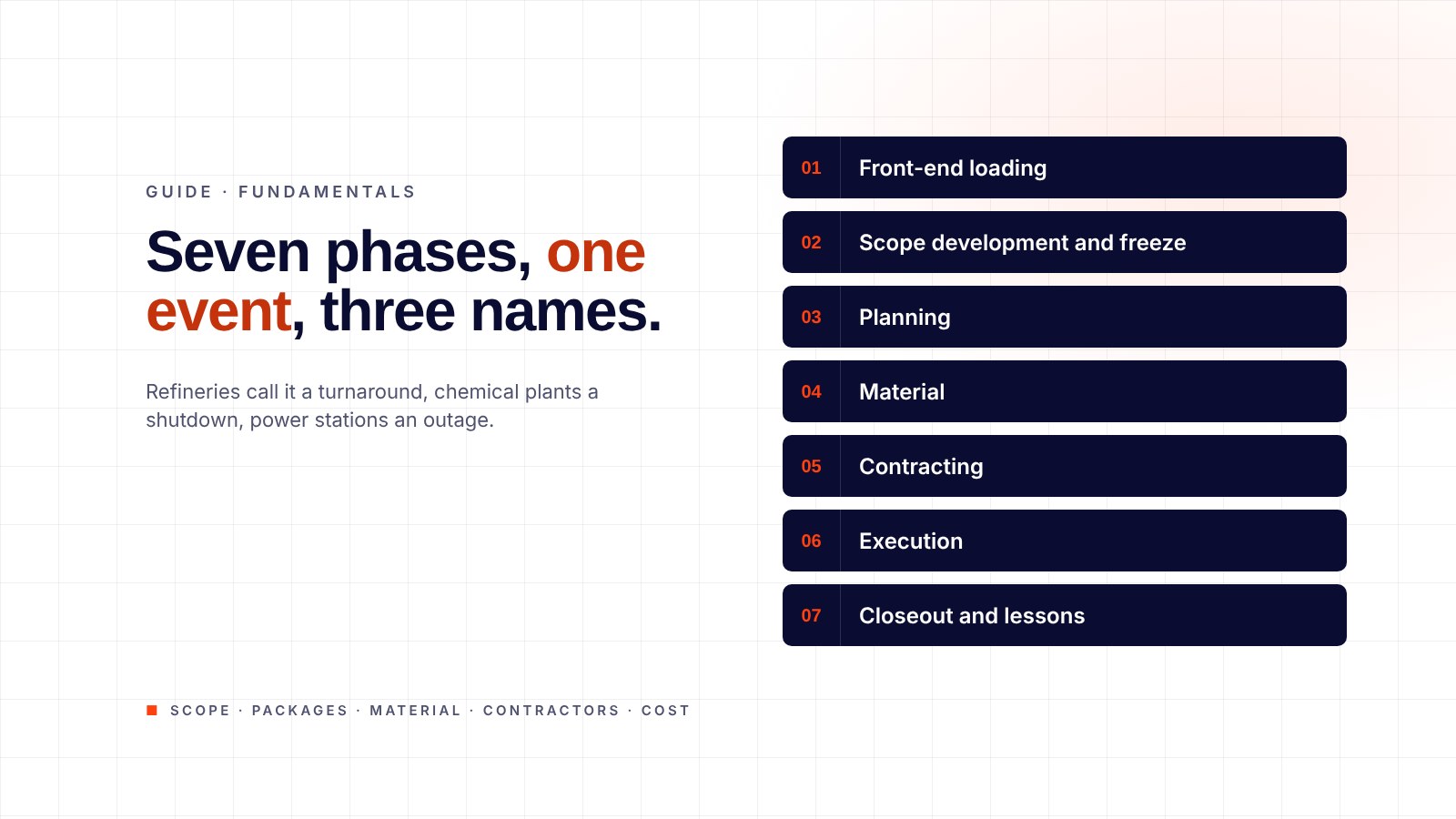
04The seven phases
Front-end loading. Define the business case, the window and the budget. Identify long-lead material, often 40 weeks or more out.
Scope development and freeze. Build the scope list from inspection history, reliability data and capital projects. Freeze it, with a change process for anything added later.
Planning. Develop a work package per scope item: steps, crew, duration, permits, isolations, drawings. Estimate hours and cost. Sequence the packages into a schedule.
Material. Requisition, purchase, receive and stage material against each package and its activity date.
Contracting. Issue scope to contractors, compare bids, award, and build the manpower plan by day.
Execution. Shut down, open the equipment, do the work, capture progress, QA and discovery work by shift, and close each package within hours of completion.
Closeout and lessons. Reconcile cost, close purchase orders, record what changed, and carry the packages and lessons into the next cycle.
05Who is involved
A turnaround manager owns the event. Planners build the packages. A scheduler owns the critical path. A material coordinator owns requisition to staging. A cost engineer owns the budget and forecast. Operations owns the shutdown and start-up. Inspection and QA own the findings. Contractors, often the majority of people on site, execute the work. On a large event the planning team alone can be 20 to 40 people for a year.
06What turnaround planning involves
Planning is phases 2 through 5: turning a scope list into packages that a crew can execute, with the material staged, the contractor awarded and the cost known before the unit comes down. The measure of good planning is readiness at the gate: what share of packages are complete, what share of material is staged, and how much scope was added after the freeze. The measure of poor planning is discovered in execution, as idle crews, emergency orders and a schedule nobody trusts.
07Where turnarounds go wrong
| Failure | When it shows |
|---|---|
| Scope added after the freeze without approval | On the invoice |
| Material tracked only to the warehouse dock | The morning the crew needs it |
| Work packages kept in contractors' own tools | At demobilization, when the knowledge leaves |
| Progress collected by phone and radio | In the close-out backlog at the end of the event |
| Cost assembled monthly from contractor reports | Three weeks after the decision it should have informed |
| Each event planned from scratch | Every cycle |
08A turnaround by the numbers
| Measure | Typical range |
|---|---|
| Planning lead time | 12 to 18 months |
| Long-lead material ordered | 40 weeks or more ahead |
| Execution window | 2 to 8 weeks |
| People on site at peak | 500 to 3,000 |
| Work packages on a large unit | 300 to 1,500 |
| Material share of spend | 30 to 40% |
| Scope added after the freeze | 5 to 15% of hours |
| Cycle between turnarounds on one unit | 3 to 6 years |
09Terms used on every turnaround
| Term | Meaning |
|---|---|
| Scope freeze | The date after which additions need formal approval |
| Work package | The planned job for one scope item: steps, crew, duration, permits, drawings, material |
| Front-end loading (FEL) | The planning done before the event is approved and funded, checked at gates |
| Long-lead material | Items whose lead time sets the planning calendar |
| Discovery work | Scope found when equipment is opened, added after the freeze |
| Laydown yard | The area where material is received and held before staging |
| Staging | Setting material aside for a specific package before it is needed |
| Close-out | Closing a package after the work is complete, with QA accepted |
| PMI | Positive material identification: confirming the alloy of an installed item |
| Readiness | The share of packages that can be executed as planned on the day they are needed |
10Where software fits
A scheduler holds the activities and the critical path, and an ERP holds purchasing and finance. Neither holds the work itself. Turnaround software sits between them: the scope and work packages, the material from requisition to installation, the contractor estimates and daily cost, and the field capture that keeps all of it current by shift. The EZTRAK platform does that with three modules: Pilot for planning and execution, Flow for material and Vault for cost, working alongside SAP and Primavera P6.
11How to tell a well-run turnaround from a poorly run one
Ask four questions after the event. Did it finish on the date, measured in shifts? Did it finish on budget, including the scope added after the freeze? How many jobs were still open 24 hours after the work was done? And could the next turnaround on the same unit start from this one's packages, material lists and contractor performance, or will it start from a blank sheet? A site that can answer all four from a system, rather than from memory, has the planning under control. A site that can answer none of them is paying for the same lessons every cycle. The gap between the two is rarely effort; it is where the information lived while the event was running.
12Where EZTRAK fits
13Frequently asked questions
How long does a turnaround last?
Execution usually runs two to eight weeks. Planning starts 12 to 18 months earlier, and long-lead material is ordered 40 weeks or more ahead.
How often does a unit have a turnaround?
Every three to six years, set by inspection intervals, catalyst life and regulatory requirements.
What is the difference between a turnaround and routine maintenance?
Routine maintenance happens while the unit runs. A turnaround is the work that needs the unit down, done all at once to limit lost production.
What is STO?
Shutdown, turnaround and outage: the collective term for the same kind of event across industries.
See the seven phases on one platform.
Fifteen minutes on a live system: scope, packages, material, contractors and cost in one place. Or call 626-327-6348.