
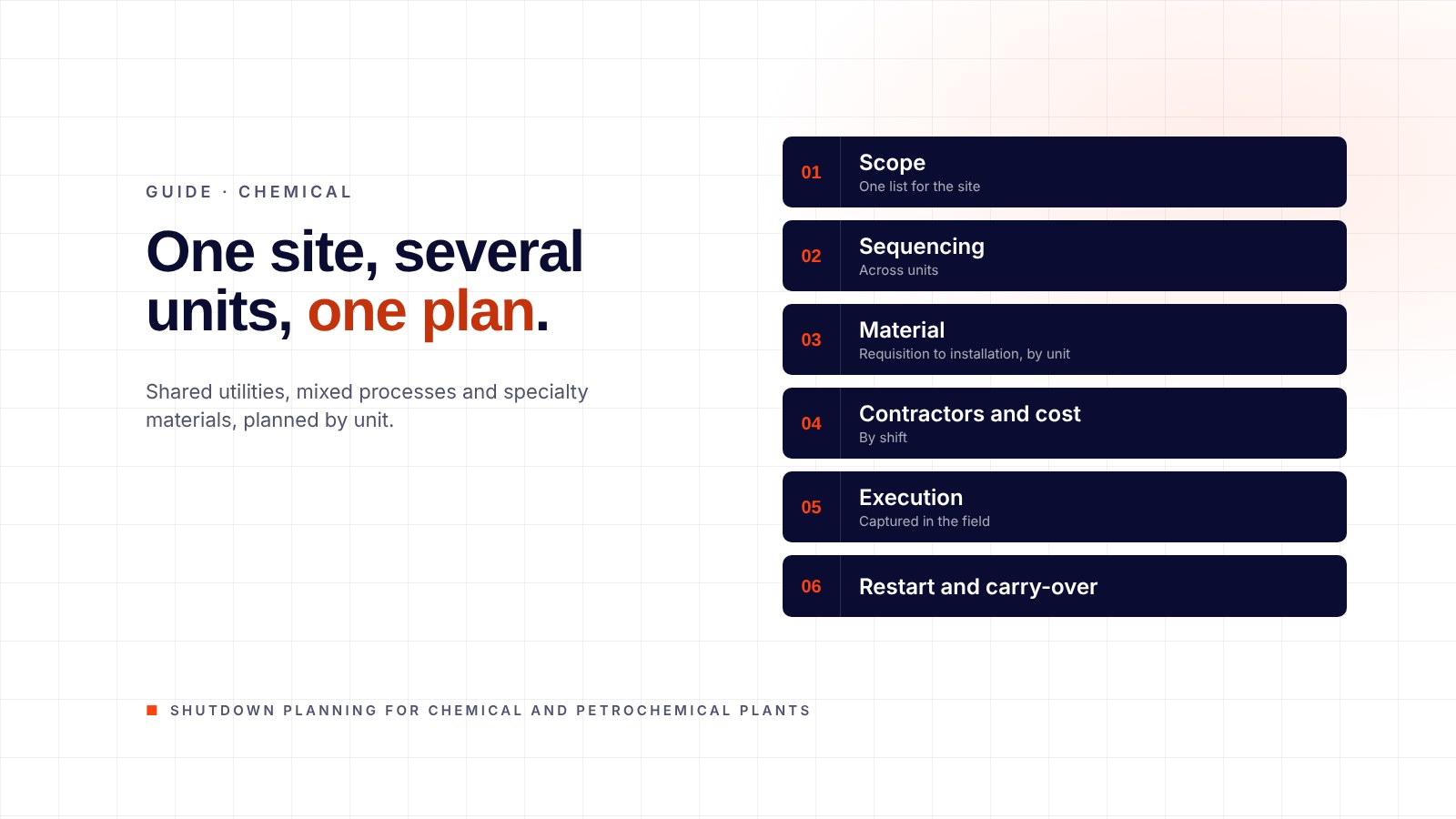
01What is different about a chemical shutdown
A refinery turnaround usually takes one large unit down. A chemical or petrochemical shutdown often takes several smaller units down in a sequence set by shared utilities: steam, cooling water, flare, nitrogen and waste treatment. The sequence is a plan in itself, and a slip on one unit moves the rest.
The material is different too. Lined vessels, exotic alloys, specialty gaskets, agitator seals and instrumentation specific to one process carry lead times of 20 to 50 weeks and come from a short list of suppliers. There is no local stock to fall back on. A wrong alloy installed in a corrosive service is a safety event, so material verification matters more than on most refinery scopes.
The third difference is the plant itself. Batch units, continuous units and utilities share the fence, and the scope on each is owned by a different operations group. Planning has to hold all of it in one place or the shutdown becomes three shutdowns run in parallel by three teams.
02Scope: one list for the site
Build one scope list for the whole event, with the unit, the system and the owning operations group on every line. Freeze it once, site-wide, with one change process. Scope that is added by one unit after the freeze competes for the same crews, cranes and laydown space as every other unit; it has to be visible to the event, not just to the unit that added it.
For each scope item, record the work package number, the long-lead flag and the lead time in weeks. The long-lead list is the first output of planning and it drives the purchasing calendar.
03Sequencing across units
| Step | What to fix | Why |
|---|---|---|
| 1 | Utility shutdown and restart order | Every unit depends on it |
| 2 | Critical path per unit | Each unit has its own |
| 3 | Shared resources by day: cranes, scaffold, laydown, specialist crews | These are the real constraints between units |
| 4 | Hand-offs between units | Where one unit's restart gates another's |
| 5 | Restart sequence and the date each unit returns to operations | The number the business is waiting for |
The scheduler holds the logic. The planning system holds the packages, material and cost each activity depends on, and tells the scheduler when something it depends on is late.
04Material: requisition to installation, by unit
Track every item from requisition and purchase order through receipt, staging, issuing and installation, with the unit and the package it belongs to. Three controls matter more on a chemical site:
Shortages measured against the activity date per unit, so a late seal on unit B is not hidden inside a site-wide received percentage.
Positive material identification and mill test reports tied to the item, not filed in a cabinet, so the alloy installed can be proven later.
Staging by package, so crews on three units do not draw from one pile.
Material is 30 to 40% of shutdown spend and tracking usually stops at the warehouse dock. On a multi-unit site that is where the losses, the duplicate orders and the expediting hide.
05Contractors and cost by shift
Several units mean several contractor packages and, often, several contractors for the same craft. Have every contractor estimate and report in one format inside the owner's system, so bids compare line by line and the daily cost report exists at the end of the shift. Track headcount planned against actual by contractor by day; on a sequenced shutdown a contractor running over on unit A is the earliest warning for unit B.
Scope changes should be approved before the work starts, with their hours and cost, and should move the forecast the same day. The forecast should be readable by unit and for the site.
06Execution: capture in the field
Progress, QA and discovery work are captured on the job, by shift, on a phone. Each package is closed within hours of the work, so the restart decision on each unit rests on packages that are closed, not on a list of jobs someone believes are done. On one site, capturing completion in the field with QA notified at once moved close-out from over 72 hours to under 24.
07Restart and carry-over
Restart each unit on its closed packages, reconcile its cost, and close its purchase orders. Then keep the packages. The next shutdown on the same unit should start from this event's packages, material lists and contractor performance, not from a blank sheet.
08Common mistakes on chemical shutdowns
Three unit plans and no site plan, so cranes, scaffold and specialist crews are double-booked on the same day.
One received percentage for the site that hides a critical shortage on one unit.
Specialty material ordered after the scope freeze, when the lead time was longer than the time left.
PMI results kept on sheets by part number, so the alloy installed in a corrosive service cannot be proven later.
Each unit's contractors reporting cost in their own format, so the site forecast is assembled once a week by hand.
Packages kept by the contractor, so the next shutdown on the same unit starts from nothing.
09The site-wide plan, in one page
| Item | Owner | Measure at the gate |
|---|---|---|
| One scope list with unit and system on every line | Turnaround manager | Items without a package: zero |
| Long-lead list with lead times | Material coordinator | Long-lead items without a PO: zero |
| Utility shutdown and restart sequence | Operations | Agreed and dated |
| Shared resources by day | Scheduler | Crane, scaffold and specialist crew calendar loaded |
| Packages complete per unit | Planning lead | Percentage per unit |
| Material staged per package | Material coordinator | Percentage per unit; shortages against activity date |
| Estimates in one format | Cost engineer | Percentage of packages |
| Field capture tested | Execution lead | One package end to end on a phone |
10Where EZTRAK fits
EZTRAK is shutdown management software for chemical and petrochemical plants: planning, execution, material management and project controls on one platform, by unit and for the site. Pilot holds the scope, packages and field capture; Flow follows material from requisition to installation with PMI records on the item; Vault carries estimates, bids, daily cost and the forecast. It works alongside SAP and Primavera P6 and rolls out in four to six weeks.
11Frequently asked questions
Can one system plan several units on different cycles?
Yes. Scope, packages, material and cost carry the unit on every line, so the event reads as one plan or as five.
How early does planning start?
Long-lead material sets the clock. With 20 to 50 week lead times on specialty items, the scope freeze needs to sit 12 months or more ahead of the window.
Do batch units need the same packages as continuous ones?
Yes. The work is shorter and the equipment smaller, but a package without material staged idles a crew the same way.
How is the PMI record kept?
With the item: bill of material to PMI test to installation, each step tied to a person and a timestamp, so the record exists years later.
See a multi-unit shutdown planned on one platform.
Fifteen minutes: scope, material and cost by unit, and the site-wide plan on one page. Or call 626-327-6348.