
01What PMI and MTRs are
A mill test report (MTR), also called a material test certificate, is the document the mill or manufacturer issues with a heat of material: its chemical composition, mechanical properties and the specification it meets. It travels with the material on paper or as a PDF, and it is the proof that the item was what was ordered.
Positive material identification (PMI) is the test done on site, usually with a handheld analyzer, to confirm that the alloy of a specific item matches its specification. It catches the substitution the paperwork cannot: a carbon steel flange shipped against an alloy PO, a 316 fitting in a 321 line. Owner verification programs for alloy piping are commonly built on API Recommended Practice 578.
The two records answer different questions. The MTR says what the heat is. The PMI says what this item, in this location, is. Both need to be found years later, when an inspector asks what was installed in a line in 2024.
02Why the record goes missing
| Where it breaks | What happens |
|---|---|
| Receipt | The MTR is filed by PO, not by item; three heats on one PO become one folder |
| PMI testing | The result is written on a tag or a sheet, keyed to a part number that twenty items share |
| Staging | The item moves; the tag does not, or the tag moves and the sheet does not |
| Issue | The crew takes the item; nobody records which tested item went to which package |
| Installation | The equipment tag is known; the heat and the PMI result are in two cabinets |
| Years later | Proving what was installed means reconstructing the chain from paper |
03The seven-step chain
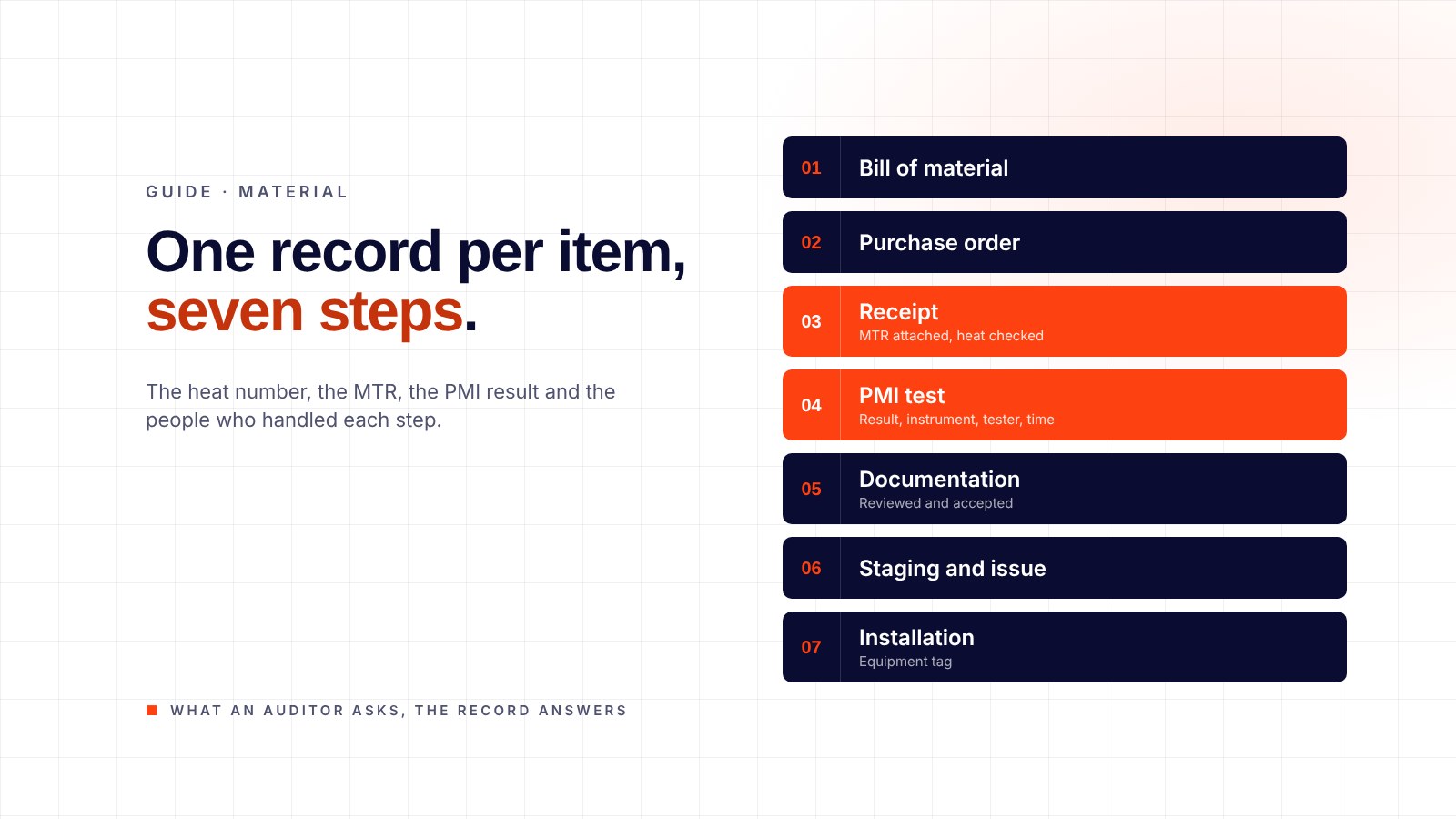
Keep one record per item, and add to it at each step.
Bill of material: the item, its specification and the alloy required, tied to the work package.
Purchase order: the PO line, the supplier and the heat number once known.
Receipt: the MTR attached to the item record, with the heat number checked against the paperwork.
PMI test: the result, the instrument, the tester and the time, on the item.
Documentation: the MTR and PMI result reviewed and accepted, with the reviewer's name.
Staging and issue: the item's location and the package it was issued to, with who issued and who received it.
Installation: the equipment tag and location, the installer and the time.
At step 7 the record is complete: specification, heat, MTR, PMI result, package, equipment tag, and the people who handled each step. It lives with the item, not in a cabinet.
04Attribution
Every step is tied to a person, an item and a timestamp. That is what makes the record defensible. A PMI result on a sheet says an item of that part number passed on a date. A PMI result on the item record says this item, received against this heat, was tested by this person at this time and installed at this tag by that person. When an inspector or an auditor asks, the answer is one screen.
05What to do on an event already underway
Start at receipt. Every item received from today carries its MTR on its record and its PMI result when tested. Items already on site are added as they are staged, with the PMI done then if it was not done at receipt. The chain is incomplete for those items at the front end, but complete from staging to installation, which is the part that matters most to the later question.
06Receipt checklist for alloy items
Heat number on the material matches the heat number on the MTR.
MTR specification matches the purchase order specification.
MTR attached to the item record, one record per heat.
PMI done at receipt where the program requires it, result on the item.
Item tagged with its record identifier, not only its part number.
Discrepancies quarantined and recorded, not set aside.
07What an auditor asks, and what the record answers
| Question | Answer from the item record |
|---|---|
| What alloy is installed at this tag? | The specification, the heat and the PMI result |
| Who tested it, and when? | The tester, the instrument and the timestamp |
| Where is the MTR? | Attached to the item, by heat |
| Which items came from that heat, and where are they? | Every item on the heat, with its equipment tag |
| Who installed it? | The installer and the time, on the item |
| Was anything substituted? | The receipt record shows what was received against what was ordered |
08Common failures and the fix
| Failure | Fix |
|---|---|
| MTRs filed by PO | One record per heat, attached to each item from it |
| PMI results on a sheet by part number | Result on the specific item, with the tester |
| Tag separated from the item at staging | The record identifier follows the item through issue |
| Installation recorded by equipment tag only | Installation step on the item record names the tag |
| Records assembled after the event | Each step recorded when it happens, by the person who did it |
09Why this matters more each year
Alloy piping systems on refineries and chemical plants accumulate changes over decades: a spool replaced in one turnaround, a flange in another, a valve on a maintenance call in between. Each change is a chance for the wrong material to enter service, and each is a record that has to be found when a failure is investigated or an inspection program is reviewed. A paper record survives the event; it rarely survives ten years and three reorganizations. One record per item, with the heat, the test, the people and the equipment tag, is the version that is still there when the question is asked. It costs seconds at each step to create and nothing to keep.
10Where EZTRAK fits
EZTRAK Flow keeps one digital record per item from bill of material through PMI testing, documentation, staging and field installation, with every step tied to a person, an item and a timestamp. The MTR is attached at receipt, the PMI result is captured on the item in the field, and the installation record names the equipment tag. Issue No. 8 has the field view of the same chain.
11Frequently asked questions
Is PMI required on every alloy item?
Owner programs set the sampling: 100% on some services, a sample on others. Whatever the policy, the result has to be found later, which is the problem this chain solves.
Can the MTR be a PDF?
Yes. It is attached to the item record at receipt and checked against the heat number on the material.
What if the supplier sends one MTR for several heats?
Record each heat against the items received from it. One PO with three heats is three records, not one folder.
Who does the PMI test?
Usually a third-party inspector or the owner's inspection group. The result is recorded on the item at the time of the test, by the person who did it.
See Flow from requisition to installation.
Fifteen minutes: one item followed through the six steps, with the records on the item. Or call 626-327-6348.