
01What leaves the gate
| Work | Typical shop | What comes back |
|---|---|---|
| Exchanger bundles | Retubing and repair shops | Repaired or new bundle, test records |
| Valves | Valve repair shops | Overhauled valve, test certificate |
| Pipe spools | Fabrication shops | New spools, weld records, NDE reports, MTRs |
| Rotating equipment | OEM or repair shops | Rebuilt pump or compressor, balance and test reports |
| Vessels and internals | Fabrication shops | Fabricated internals, inspection records |
Each of these is on the critical path of a package and each has a return date the schedule depends on. The shop also holds documentation the owner needs at installation and for years afterwards.
02Why visibility breaks
The shop runs its own system, or a whiteboard. Status reaches the owner when the expeditor calls. Documentation arrives with the item, after it, or in a box at the end of the event. On one job, hundreds of pipe spools came back without proper labels or the required test records, and re-verifying them took days that were not in the plan.
The owner's planning system knows the item left and knows the date it is due back. It knows nothing in between, which is where the slip happens.
03The milestones to track per item
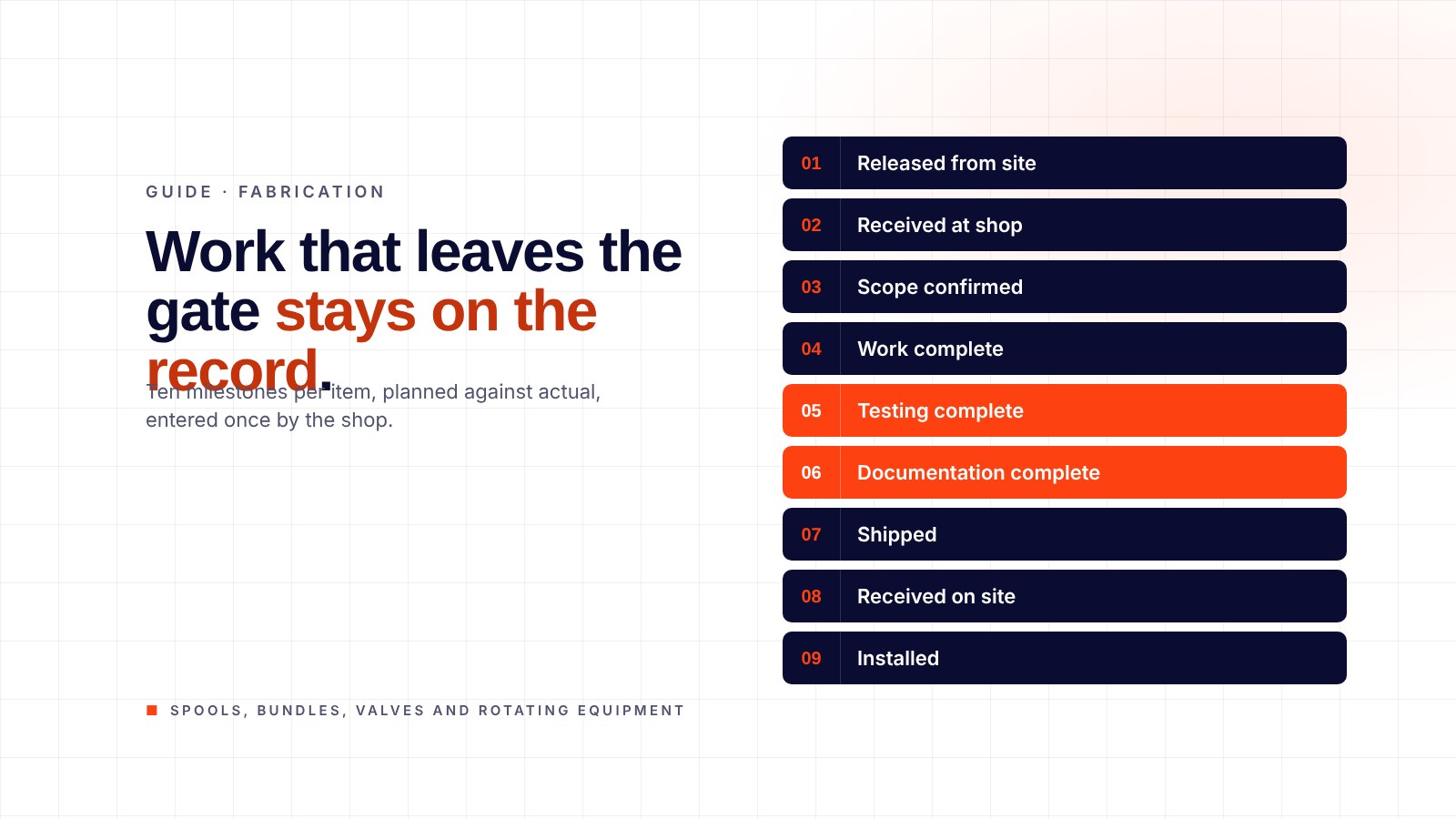
Released from site: date, carrier, the shop, and the package and activity date the item belongs to.
Received at shop: date confirmed by the shop.
Inspection and scope confirmed: what the shop found and what it will do, with any scope change approved before work starts.
Work started.
Work complete.
Testing complete: hydrotest, NDE, balance, whatever the item requires, with the records attached.
Documentation complete: the records reviewed and accepted.
Shipped: date and carrier.
Received on site: date, condition, labels checked against the record.
Installed: equipment tag, date, installer.
Each milestone has a planned date from the schedule and an actual date entered by the shop. The gap between them is the status, and it is visible without a phone call.
04Documentation with the item
The records the shop produces belong on the item record, not in a box: weld maps, NDE reports, hydrotest certificates, MTRs for new material, PMI results, balance reports, dimensional checks. Attach each at the milestone that produces it. When the item arrives on site, the record is already complete and the receiving check is a comparison, not a reconstruction.
05Chain of custody
Every hand-off is recorded: who released the item, which carrier took it, who received it at the shop, who shipped it back, who received it on site. For alloy items and pressure parts this is the same chain that makes PMI and MTR records defensible. For everything else it is how a missing spool is found.
06Bringing the shop into the system
Shops will work inside the owner's system if it costs them less than the phone calls. Give each shop time-limited access to its own items only, with the milestones to tick and the documents to attach. Most shops train in about 30 minutes. The shop's status becomes the owner's status the moment it is entered.
07All year, not just the event
Offsite fabrication and repair runs year-round: turnarounds, capital projects and daily maintenance all send work out. The same milestones and records apply to a single valve sent out in March as to two hundred spools before the fall turnaround. A system used all year is also one the shops already know when the event starts.
08A worked example: 200 spools before a fall turnaround
Two hundred pipe spools go to a fabrication shop in June for an October turnaround. Each spool leaves with a record: its package, its activity date, its drawing and the test records it must come back with. The shop ticks milestones as it goes and attaches weld maps, NDE reports and MTRs at the milestone that produces them. In August, 30 spools are two weeks behind. That shows against their activity dates, by package and by contractor, without a phone call, and the scheduler re-sequences the affected packages in August rather than finding out in October.
In September the spools arrive on site with labels that match the record, and the receiving check is a comparison. Nothing is re-verified. The documentation is complete before the first spool is lifted.
09What to put in the shop's purchase order
The milestones the shop will record, with planned dates.
The documents it will attach at each milestone, by name.
Labelling: the record identifier on every item.
Access: the shop's users, and that access is limited to its own items.
Training: a 30-minute session before the first item ships.
That status is entered in the system, not reported by phone.
10What to measure
| Measure | Target |
|---|---|
| Items offsite with a planned return date | 100% |
| Items with a milestone update in the last seven days | 100% |
| Items returning with complete documentation attached | 100% |
| Items re-verified on receipt | Zero |
| Slips known before the return date | All of them |
11The shop's side of it
Shops resist new systems because every owner has one and each costs them time. The case to make is that this one replaces the expediting calls, the emailed photos and the re-sent certificates with ten milestones and a few attachments, entered once. A shop that updates the record is not asked for status; a shop that attaches the records at the milestone is not chased for them in October. Most shops see it in the first month, which is why a 30-minute training session is enough. The owner's side is simpler still: the planner who used to call six shops on Monday reads one screen, and the scheduler sees a slip the day the shop records it rather than the day the truck fails to arrive.
12Where EZTRAK fits
Forge, part of EZTRAK Pilot, tracks offsite fabrication and repair on the EZTRAK platform: milestones, documentation and chain of custody per item, with shops working inside the system on their own items. Shop training takes about 30 minutes. Issue No. 15 describes the problem from the field.
13Frequently asked questions
What if a shop will not use our system?
Make it part of the purchase order. Ten milestones and a few attachments cost the shop less than the expediting calls it gets now.
Can we track items already at shops?
Yes. Enter them at their current milestone with the planned return date; the chain is complete from there.
Does this replace the shop's own quality system?
No. The shop keeps its procedures. The owner gets the milestones and the records as they are produced rather than in a box at the end.
How does this tie to the schedule?
Each item carries the package and the activity date it is needed for. A shop milestone that slips shows against that date, so the scheduler sees the risk before the return date passes.
See the shop inside your system.
Fifteen minutes: ten milestones per item, planned against actual, documentation on the record. Or call 626-327-6348.