
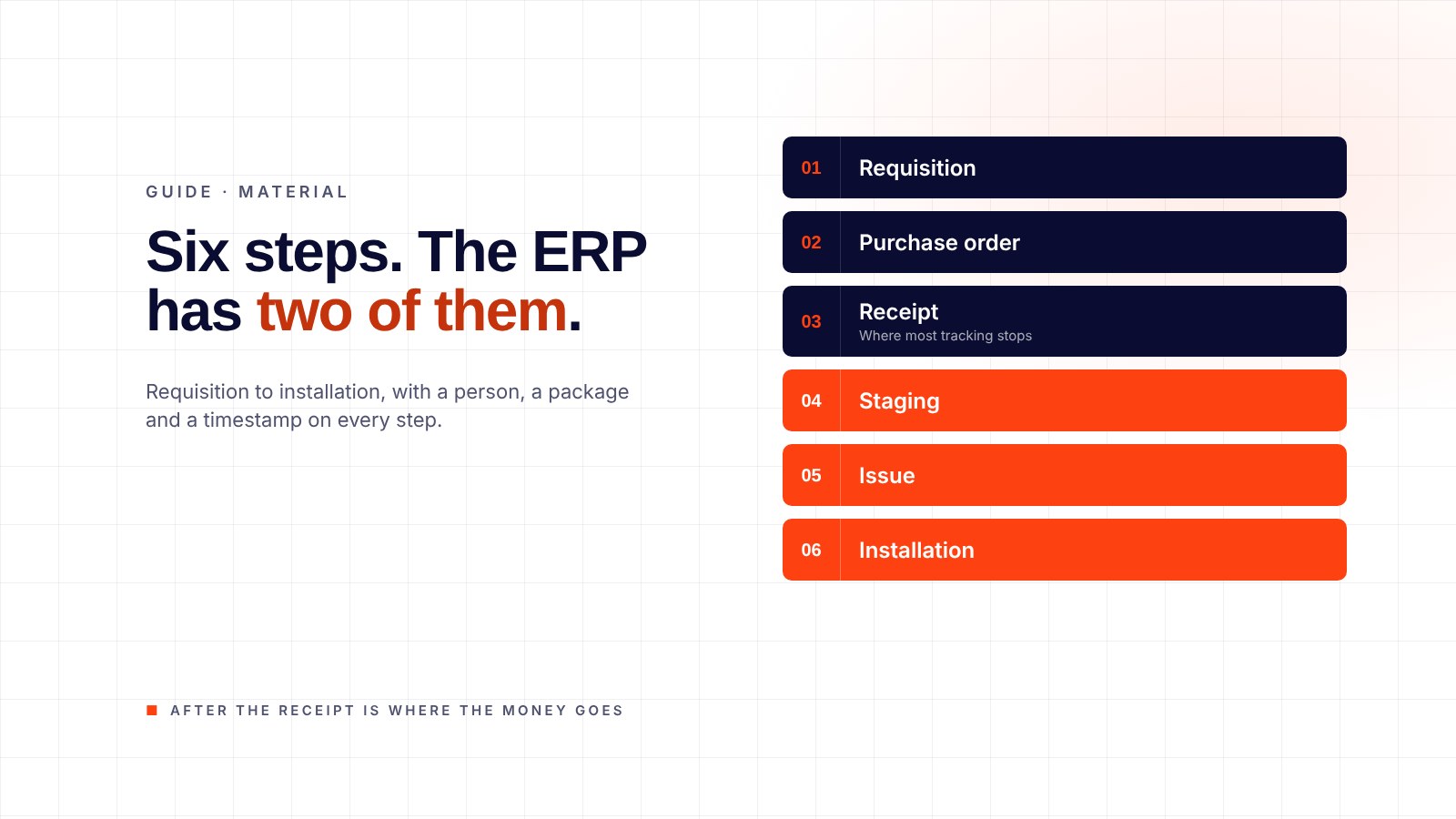
01Where tracking stops
The ERP tracks a purchase order to receipt and then to the invoice. From the ERP's point of view, an item received at the dock is done. From the turnaround's point of view, the item has four steps left: it has to be found, staged for its package, issued to a crew and installed. None of those is in the ERP, so they live in a spreadsheet, a laydown yard map and the memory of the material coordinator.
The cost of that gap is hard to see because it never appears as one line. It appears as a crew waiting for a gasket that is on site somewhere, as a second order for a valve that was already received, as a courier charge, and as a container of surplus discovered after the event. Added up, waste runs about 10% of material cost: $3 million to $4 million on a $100 million turnaround.
02The six steps and what to record
| Step | What happens | Record on the item |
|---|---|---|
| 1. Requisition | A package needs an item | Package, quantity, the activity date it is needed, long-lead flag |
| 2. Purchase order | The requisition becomes a PO line | PO number, supplier, promised date, price |
| 3. Receipt | The item arrives | Date, quantity received against ordered, location, inspection result, test reports |
| 4. Staging | The item is set aside for its package | Staging location, date, who staged it |
| 5. Issue | A crew draws the item for the job | Date, package, who issued, who received |
| 6. Installation | The item is in the equipment | Date, equipment tag, who installed, any PMI or test record |
Each record ties the item to a person, a package and a timestamp. The result is one history per item from requisition to installation, which is also the audit trail and the surplus list.
03Readiness against the day it matters
A received percentage for the whole event hides the shortage that matters. Measure readiness per package against its activity date: is every item for this package staged before the day the crew needs it? A shortage is then a list of items whose promised date is later than the activity date, with the package and the contractor affected, not a percentage that looks fine until the morning it does not.
04The readiness window
The weeks before the unit comes down are when material spend spikes: expediting, premium freight, duplicate orders placed because an item cannot be found. On the PBF Torrance turnarounds, readiness-window material spend fell by about 68% once every item was tracked from requisition to installation. The spend did not move elsewhere; it was spend that had been caused by not knowing where things were.
05Three questions for your last turnaround
How much material was left over, and how much of it had been ordered twice?
How many emergency or expedited orders were placed in the last four weeks before shutdown?
On the day a crew could not find an item, how long did the search take, and how many people joined it?
If the answers are not known, that is the finding. The information was never recorded past the dock.
06Surplus and the next event
An item tracked to installation is either installed or surplus, and surplus is known at closeout rather than discovered later. Record it, return what can be returned, and carry the rest into the next event's requisitions. The same records give the next event its starting material list: what each package used, from whom, at what lead time.
07What good looks like, by the numbers
| Measure | Target |
|---|---|
| Items carrying a package and an activity date | 100% |
| Items with a receipt record, including test reports where required | 100% |
| Packages fully staged before their activity date | 95% or more at the execution-ready gate |
| Shortages known before the activity date | All of them; none discovered by a crew |
| Time to locate an item on site | Minutes, from the record |
| Duplicate orders | Zero |
| Surplus known at closeout | 100%, with disposition |
| Readiness-window material spend | Down; one site documented about 68% |
08Starting on an event already underway
Start at receipt. Every item received from today is recorded with its package and activity date and followed through staging, issue and installation. Items already on site are added as they are staged. Within two weeks the laydown yard is on the record and the search time drops; by execution, the four steps the ERP never had are complete for every item the crews touch.
09Common mistakes
Measuring material readiness as one received percentage for the event.
Staging by part number rather than by package, so three crews draw from one pile.
Recording issue on paper that is keyed in a week later, after the crew has moved on.
Treating contractor-supplied material as the contractor's problem until it idles the owner's schedule.
Discovering surplus in a container after the event, with no record of what it was ordered for.
10What the record is worth afterwards
An item tracked to installation leaves a history that is useful long after the event. For inspection and audit, it answers what was installed at a tag, from which purchase order and heat, and by whom. For the next turnaround, it is the starting material list by package, with the supplier and the lead time that was actually achieved. For procurement, it is the surplus and the duplicate orders, by item, with the reason. For the business, it is the difference between a material budget built from the last event's actual consumption and one built from a guess. The four steps after the dock take seconds each to record. The reconstruction they replace takes weeks, when it is possible at all.
11Where EZTRAK fits
EZTRAK Flow is turnaround material management software that tracks every item from requisition and purchase order through receipt, staging, issuing and installation, with the package, the activity date and the person on each step. It connects the ERP to the field: SAP or Maximo stays the system of record for purchasing, and Flow carries the item from the dock to the pipe. At PBF Torrance, EZTRAK has managed and tracked $226.6 million in material across 128 turnarounds and capital projects; the case study has the numbers, and Issue No. 2 has the field view.
12Frequently asked questions
Does this replace the ERP for purchasing?
No. Requisitions and purchase orders stay in SAP or Maximo. Flow reads them and carries the item through the four steps the ERP does not have.
Who records the staging and issue steps?
The material coordinator and the crews, on a phone, with a scan. A step takes seconds; the search it replaces takes hours.
How do contractors draw material?
Through the system, against their package. The issue record names the person, the package and the time, so the question \"who has the valve\" has an answer.
What about material the contractor supplies?
Track it the same way from receipt. A contractor-supplied item that is late idles the same crew.
See Flow from requisition to installation.
Fifteen minutes: one item followed through the six steps, with the records on the item. Or call 626-327-6348.