
Where is your PMI documentation right now?
Positive material identification, digitized end to end — from bill of material to field installation.
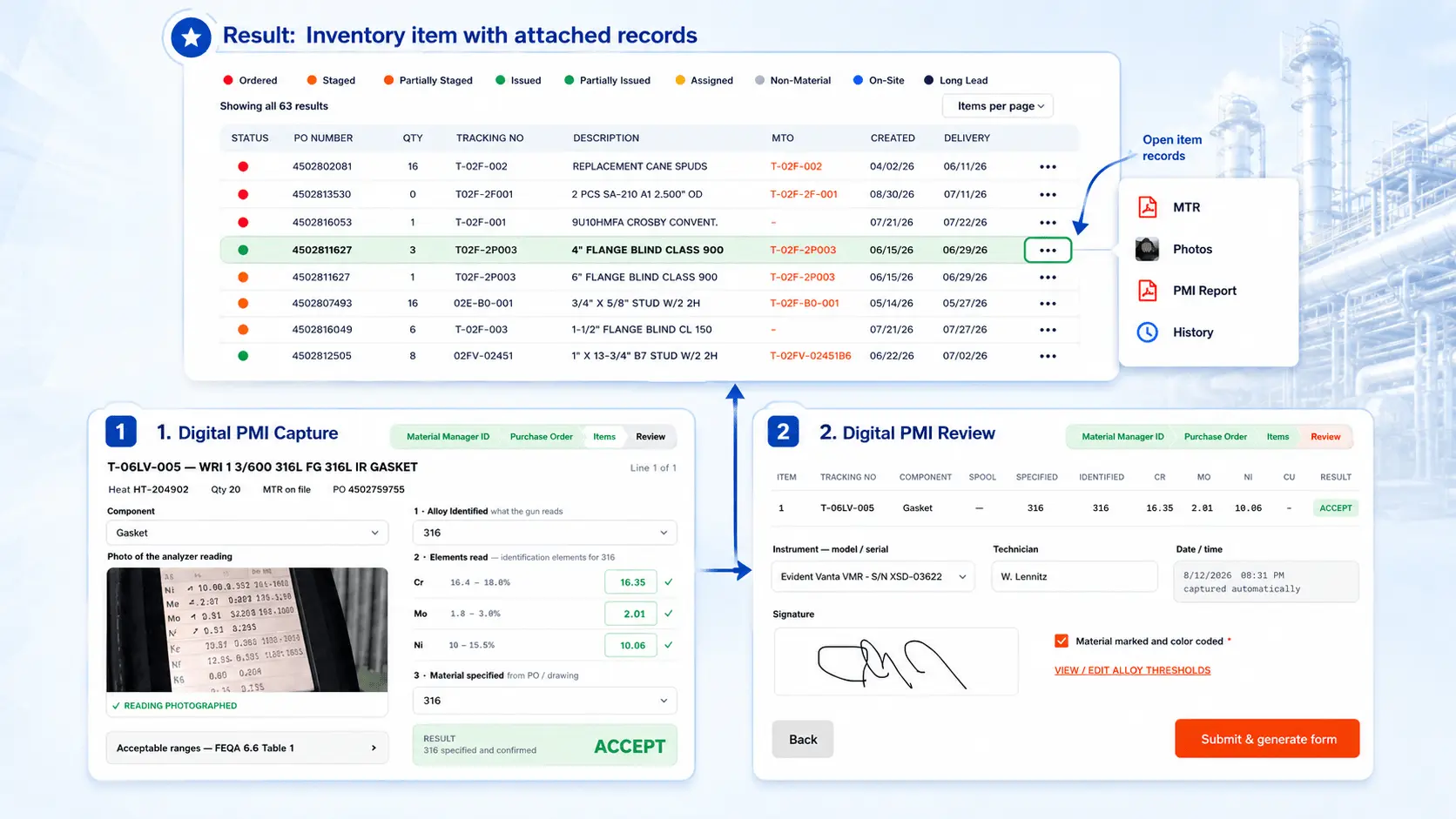
Positive material identification is one of the most consequential checks on a turnaround. Put the wrong alloy in high-temperature service and the consequence isn't a schedule problem — it's a mechanical integrity problem that may not surface for years.
At most refineries, that check still runs on paper. A tech shoots the material, writes the reading on a form, and the form goes in a folder. Ask two years from now whether a specific spool was verified, and the answer depends on whether that piece of paper still exists and whether anyone can find it.
We've digitized it end to end
Every PMI-controlled material item now carries a permanent digital record — from bill of material through PMI to field installation, with the reading attached to the specific item rather than a form in a cabinet.
The chain
- Bill of Material — the item exists in scope, tied to its work package
- Requisition and PO in SAP — purchasing stays where it lives
- Gross receipt in SAP — carries into EZTRAK with PO and line reference intact
- PMI test — alloy, reading, technician, date, pass or fail, against that item
- MTRs, packing slips, photos — attached to the item, not a folder
- Stage and issue — yard location, then signed out to a named recipient
- Installed in the field — closed out where it went
Every step is timestamped and attributed. Not a form in a folder — a transaction tied to a person, item and timestamp.
A handwritten form in a filing cabinet. Verification depends on the document surviving and someone being able to find it years later.
The reading, technician, date and result attached to the item itself — alongside its MTR, packing slip, photos, yard location, recipient and installation point.
You wouldn't accept an undocumented weld. Why accept an undocumented material verification?