
You can't benchmark what wasn't captured the same way.
Contractor cost enters the organization in a different shape at every event. Until that changes, no comparison you build is really a comparison.
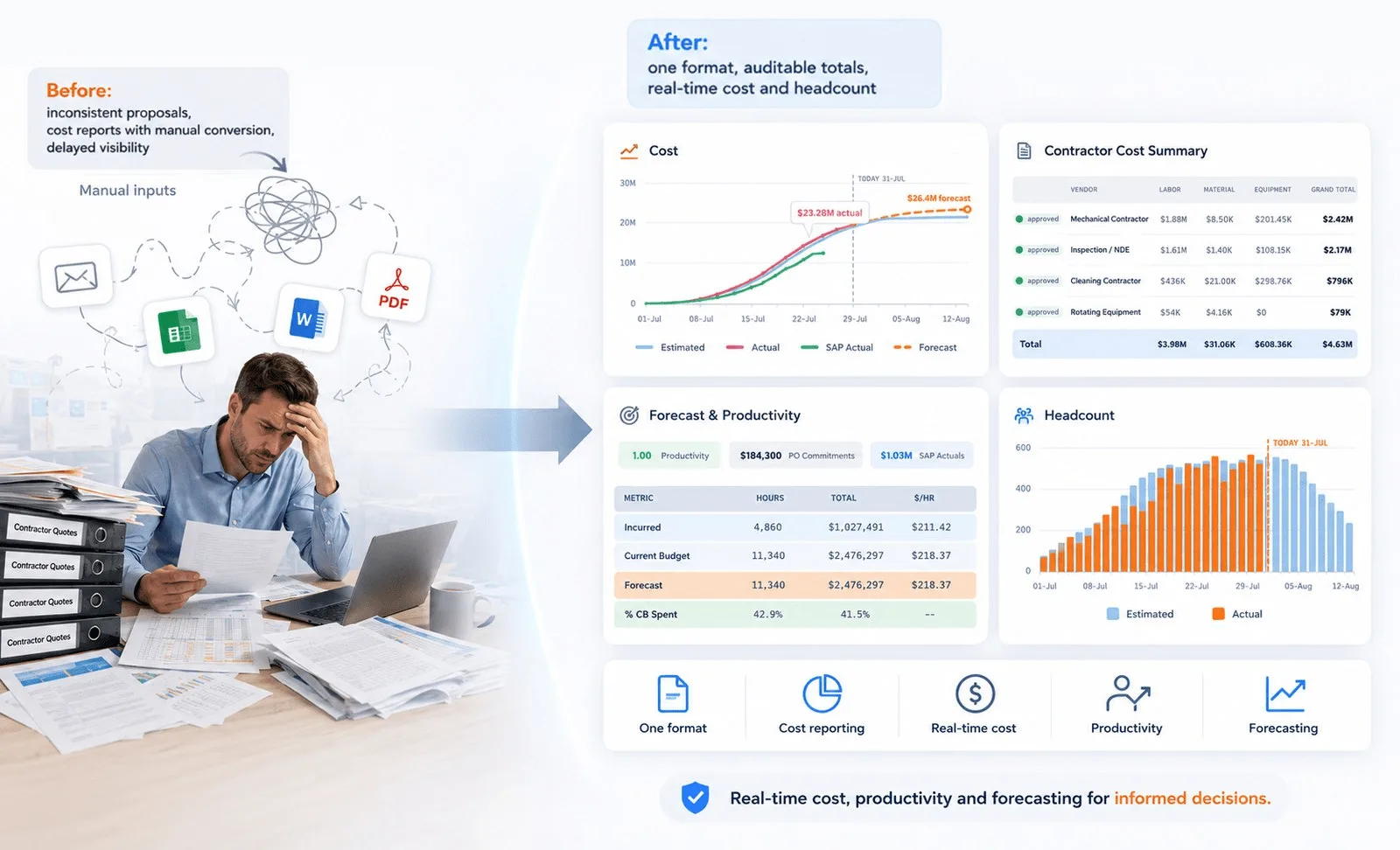
Every turnaround organization wants to know whether the last event went better than the one before it. And the answer always takes weeks to assemble, then arrives with caveats.
That isn't a reporting problem. It's an input problem.
Cost reporting inherits the shape of the quote
Contractor quotes arrive as spreadsheets, Word documents, PDFs — sometimes the body of an email. Some priced by job, some by craft, some with hours broken out and some without. Before anything can be compared, somebody rebuilds them all in a common format.
That work isn't analysis. It's conversion. And every team does it a little differently, because every team is solving the problem locally.
On a 21-day turnaround with 50-plus contractors, that's more than a thousand contractor-day cost reports arriving during execution — much of that data still compiled and reconciled manually.
And there's a second cost
Quotes are often requested by planners over email, one contractor at a time. Scope, responses and award decisions end up scattered across inboxes and spreadsheets, leaving procurement without a consistent view of how contractors were compared.
Standardize the input, not the report
Most attempts at cost visibility standardize the output — a common template everyone fills in. That only standardizes the presentation, not the underlying data.
The alternative is to standardize where the data enters. Put contractors inside the owner's system:
- One quote format, for every contractor and every event
- Rates built in, so every total is calculated from craft, hours and rate
- The planner's estimate sitting beside the contractor's
- Cost and headcount reported in that same structure, daily
A common template every site fills in after the fact. The presentation matches. The underlying data was captured differently everywhere, so the comparison still isn't valid.
Every contractor prices the same scope in the same structure, in the owner's system. What comes out is comparable because of how it went in.
What changes
Bidding becomes more transparent and competitive. Every contractor prices the same scope in the same structure, procurement can compare them line by line, and contractors know they're being evaluated on the same basis.
On a $25M turnaround, if better competition improves contractor pricing by even 1%, that's $250,000 — before considering the analyst hours spent compiling and reconciling cost data.
The comparison becomes real too — event against event, site against site, on numbers captured the same way rather than reconciled after the fact. And it compounds: every turnaround makes the next estimate better.
During the event, that same structure gives leadership current cost, productivity and forecasting — while there's still time to act.
Nobody accepts a schedule they can't audit. Cost deserves the same standard.