
Why does turnaround software need a consultant to run it?
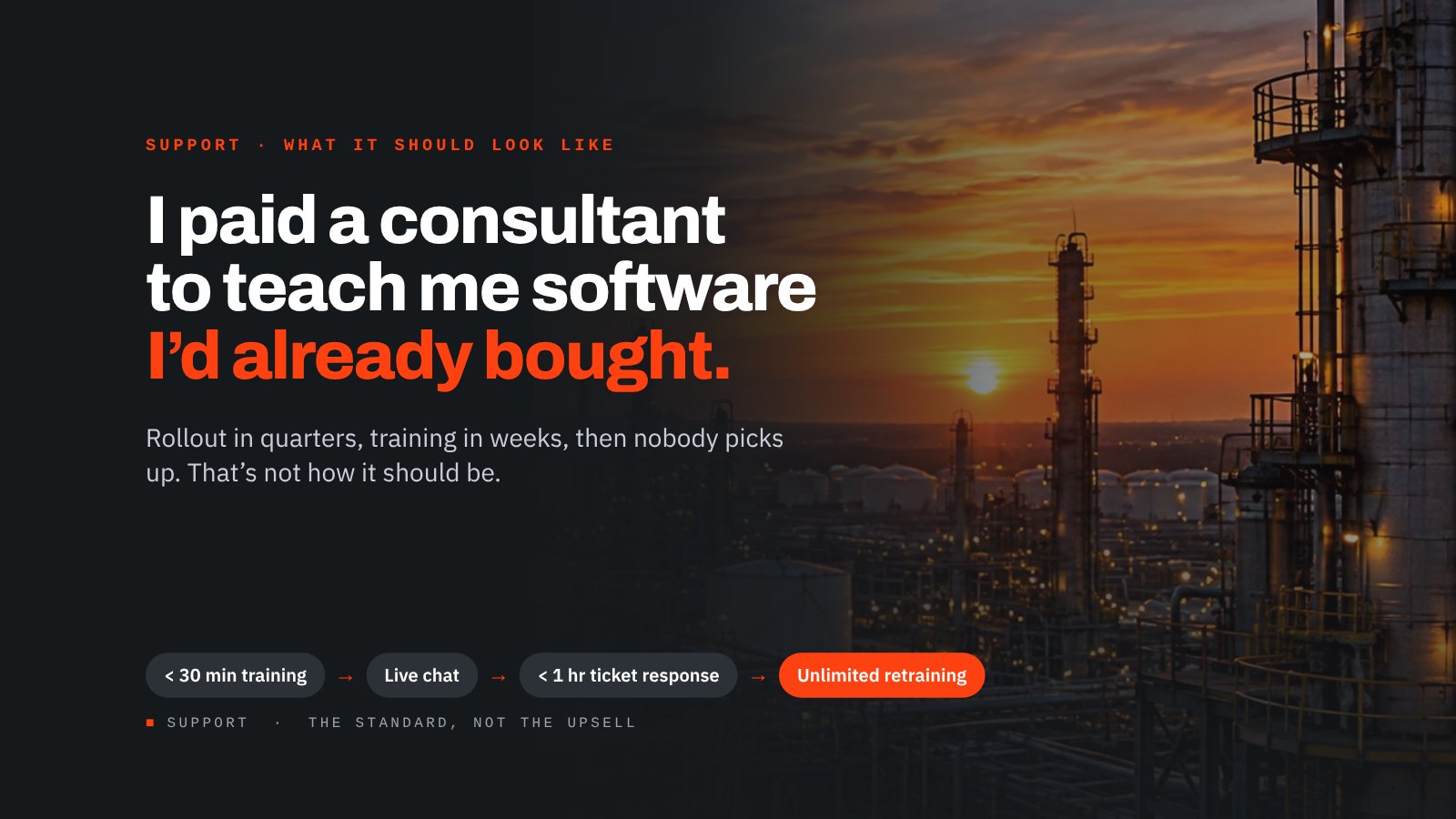
I paid a consultant to teach me software I’d already bought. It’s the complaint we hear about turnaround software: long rollout, long training, then thin air. Here’s what support should look like.
Earlier this year I signed up for a piece of software for one of my businesses. Not cheap. The product was fine. The support didn’t exist: no chat, no number, a ticket queue that answered in days with a link to a help article. I ended up hiring a consultant to teach me how to use something I was already paying for.
It’s a complaint we hear often about turnaround software. A rollout measured in quarters, a training program measured in weeks, and then, once the contract is signed, thin air. When you ask for help, the answer is a quote: master users, or the vendor’s own people on site to run the system for you.
You pay for the product, then you pay to use it.
The superuser problem
Most refineries have a handful of them: three or four people who know the system because they were there for the rollout. When a new planner comes on site, he has two options. Figure it out himself, or sit with the one person who knows, who has a turnaround to plan. The vendor’s post-sales support is thin, so the superusers become the help desk. That works until one of them retires, transfers, or is out the week the event starts.
That’s not how it should be. Software for a turnaround has to be learned fast, because the people using it are planners, coordinators and contractors who are already behind, and the event doesn’t wait for a training calendar.
What support should look like
The best support is software that doesn’t need much of it. Training on EZTRAK takes the average user under 30 minutes. Not a course, not a certification: a half hour, and they’re working. If a system needs a week of training and a master user to run it, the system is the problem.
- Training videos and short clips, one task each
- Quick guides, one page each
- Live chat inside the app
- Support tickets, answered by a person
- Unlimited training, retraining and onboarding of new users, for the life of the subscription
- Your vendors onboarded and supported, same standard
When a new planner shows up at T-30, he gets an account the same day, half an hour on the packages he’s taking over, and chat open in the app while he works. By his second shift he’s entering steps and material requests like everyone else. Nobody sits with the superuser, nobody flies out, nobody bills for it.
Why we support your contractors too
Your vendors work inside the system, and contractors are resistant to new software. A contractor who can’t enter his daily cost doesn’t call us; he complains to you. So we support them to the same standard we support your planners: same chat, same tickets, same training. It isn’t generosity. Their frustration lands on our customer, so we’re compelled to.
One more thing
We also build what a site asks for. Some of what we’ve built over the years isn’t on the website, because it was built for one refinery’s way of doing things. Some of it would fit yours.
A question instead of a demo
What’s the one thing your current system can’t do, or your vendor won’t support?
Write to us and tell me. It reaches me, not a queue, and I’ll tell you whether we already have it.