Everything facility managers, reliability engineers, and project leads need — before, during, and after a planned shutdown.
Nobody plans a turnaround hoping it will go sideways. Yet overruns, contractor clashes, and surprise equipment failures eat into refinery and chemical plant budgets every single year — mostly because the planning process started too late, moved too fast, or missed critical handoffs between teams.
This guide walks through the full picture: what a turnaround planning checklist covers, why each section matters, and where digital tools from EzTrak Software can close the gaps that spreadsheets and tribal knowledge leave open.
What Industrial Turnarounds Actually Are
A turnaround — sometimes called a shutdown, outage, or STO — is a planned production halt that gives maintenance teams access to equipment that simply can’t be touched while the plant is running. Reactors, pressure vessels, heat exchangers, rotating machinery: all of it sits behind live process conditions until the day the unit goes cold.
In energy, chemical, and pharmaceutical facilities, these events are often penciled into five-year maintenance calendars years before the scaffolding goes up. That advance timeline isn’t a formality — it’s what separates a well-executed shutdown from a multi-week ordeal that drains capital and goodwill.
*Source: U.S. Department of Energy — O&M Best Practices
Think of a turnaround as a reset. Done right, it doesn’t just restore equipment to baseline — it surfaces degradation patterns, closes maintenance backlogs, and lets reliability engineers implement the upgrades that are impossible during normal operations.
Why Planning Shapes the Final Outcome
Here’s a pattern that plant managers recognize immediately: the turnarounds that spiral over budget almost never fail in execution. They fail in planning — usually three to six months before the first wrench turns.
Budget overruns in refinery turnaround planning trace back to a familiar chain of events. Scope isn’t locked down early. Contractors show up without the right certifications. Long-lead materials get ordered late. Inspectors find corrosion nobody anticipated because the previous shutdown’s data was never properly captured.
Industry data point: The American Petroleum Institute has long documented that structured asset integrity planning reduces unexpected scope growth — the single biggest driver of turnaround cost overruns.
Safety exposure also spikes during shutdowns, not because the plant becomes more dangerous by design, but because the workforce density increases dramatically. External contractors, specialty vendors, and inspection teams all work in parallel within confined spaces. Lockout-tagout compliance, confined space entry, and hot work permits aren’t bureaucratic hurdles — they’re what keeps people alive when dozens of crews are working simultaneously on adjacent equipment.
Organizations that connect incident management systems with their turnaround workflows see measurable improvements in safety performance, simply because visibility replaces assumption.
The Five Phases of the Turnaround Lifecycle
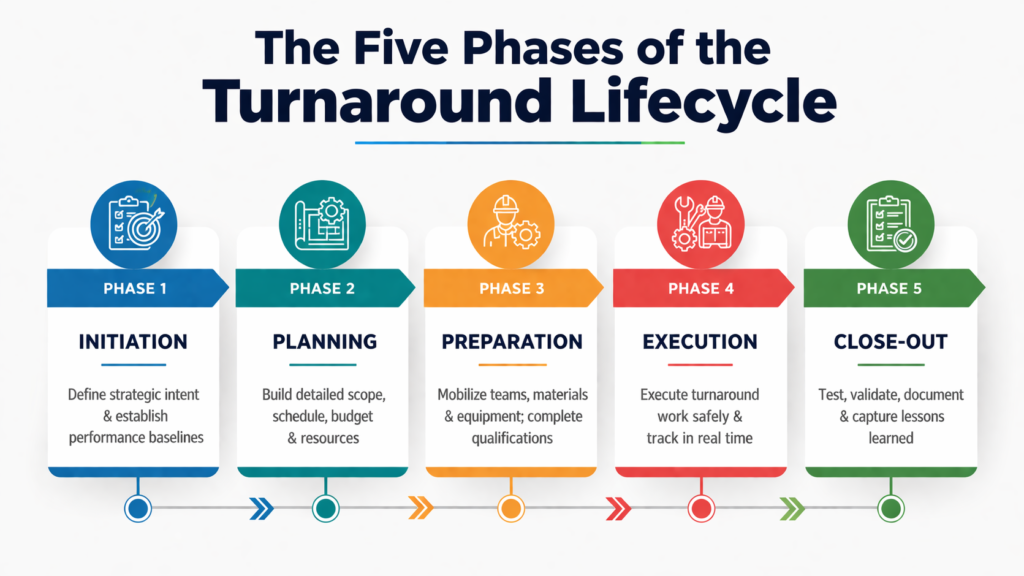
Most mature turnaround programs follow roughly the same arc, even if the labels shift from one company to the next. Understanding each phase helps teams avoid the mistakes that compound when phases blur into each other.
Phase 1 — Initiation
Leadership defines the strategic intent: regulatory inspection milestones, reliability targets, capital upgrade opportunities. Historical shutdown data gets reviewed. Recurring failure patterns inform the scope. This is also when turnaround cost forecasting baselines are established, because later changes will be far more expensive to absorb.
Phase 2 — Planning
The work breakdown structure takes shape. Materials lists grow. Engineering coordinates with project controls platforms to map dependencies, budget allocations, and risk items. Contractor capability gets mapped against scope requirements — a step that many teams leave too late, only to discover skill gaps during mobilization.
Phase 3 — Preparation
Scaffolding, equipment, and materials move into position. Contractors are onboarded. Safety briefings happen. Permit systems open. This phase is also when contractor qualification verification must be complete — not during execution, when there’s no time to fix it.
Phase 4 — Execution
The shutdown window opens. Mechanical integrity inspections run in parallel with preventive maintenance, instrumentation calibration, and pressure system work. Real-time tracking becomes critical here — not to generate reports, but to catch schedule slippage before it cascades.
Phase 5 — Close-Out
Performance testing confirms equipment is ready for return-to-service. Documentation gets finalized. Lessons learned are captured — ideally in a system that feeds them back into the next turnaround’s planning phase rather than sitting in a folder nobody opens.
Complete Turnaround Planning Checklist
Below is a structured checklist drawn from standard STO planning practice across refining, chemical, and utility sectors. Not every item applies to every facility, but experienced planners use this as a starting audit rather than a prescribed formula.
Pre-Shutdown Planning
- Define strategic objectives and regulatory inspection requirements
- Review previous turnaround data — costs, scope changes, duration overruns
- Establish turnaround management team and assign accountability
- Develop preliminary scope list from reliability and inspection backlog
- Initiate contractor qualification pre-qualification process
- Identify long-lead equipment and begin procurement cycles
- Align with inventory management on critical spare parts availability
Detailed Planning
- Finalize work breakdown structure (WBS) and work packages
- Complete risk-based inspection (RBI) prioritization
- Develop critical path method schedule with float analysis
- Lock scope freeze date and enforce change control process
- Confirm contractor contracts, safety documentation, and site induction plans
- Integrate project controls tracking into master schedule
- Finalize permit-to-work procedures aligned with OSHA PSM guidelines
Execution Readiness
- Verify all materials staged and accounted for
- Confirm contractor certifications and safety qualifications via qualification services
- Complete pre-shutdown safety walkdowns
- Brief all teams on emergency response protocols
- Activate real-time progress tracking through turnaround management software
- Confirm utility isolation sequences and permit system is active
Close-Out and Continuous Improvement
- Complete return-to-service testing and sign-offs
- Archive all inspection records and compliance documentation
- Capture lessons learned in a structured review session
- Update asset records in the enterprise management system
- Reconcile final costs against approved budget — document variances
- Feed performance data into next turnaround's planning baseline
Scope Definition and Work Breakdown Structure
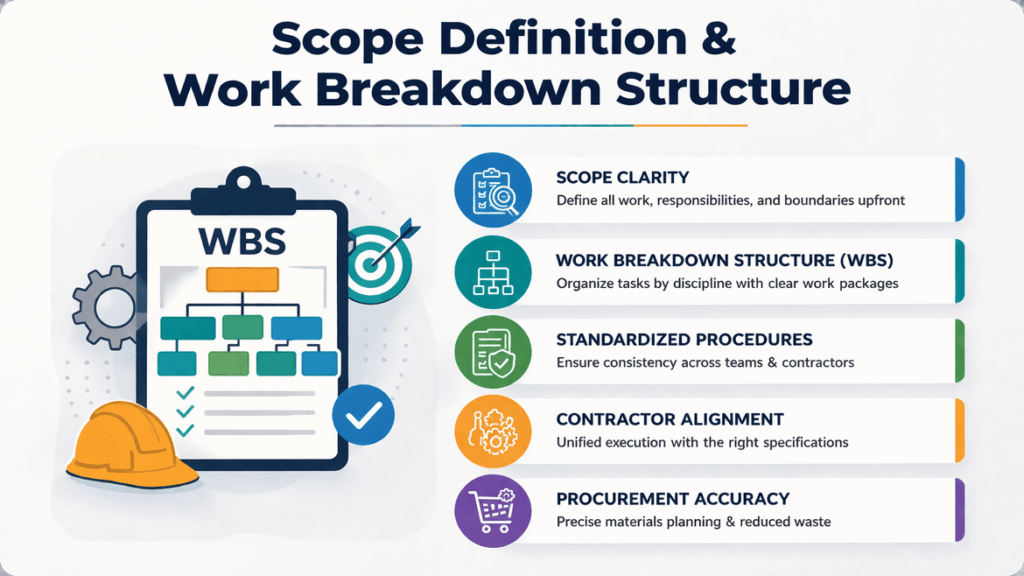
Scope creep is, without exaggeration, the most expensive line item in most turnaround post-mortems. Work gets added after the schedule is locked, contractors mobilize for jobs that weren’t in the original plan, and the shutdown window stretches. The labor rate premium for overtime alone can turn a manageable overrun into a budget crisis.
A well-constructed WBS prevents this by creating a hierarchy of work packages that each carry their own resource requirements, inspection criteria, and acceptance standards. Every discipline — mechanical, electrical, instrumentation, civil — gets its own structured work packages. Nothing sits in a gray zone.
Standardizing documentation through policies and procedures management platforms reduces interpretation errors between internal engineers and the rotating roster of external contractors that most facilities rely on during shutdowns. When everyone is working from the same version of a procedure, the chance of a repair being done to the wrong specification drops dramatically.
For facilities with multiple units shutting down on overlapping schedules, scope clarity also drives procurement accuracy — which brings us to materials.
Budget Estimation and Cost Forecasting
Anyone who has managed more than one turnaround knows that cost estimates made at the initiation stage bear only passing resemblance to what execution actually demands. Hidden corrosion. A heat exchanger that looked repairable but needs replacement. Contractor productivity that ran 20% below assumption because the scaffold wasn't in place on time.
Good cost forecasting doesn't eliminate surprises — it builds reserves against them. Standard practice allocates contingency based on scope maturity: early-phase estimates carry larger buffers that shrink as scope definition tightens.
Labor, inspection services, spare parts, scaffolding, safety equipment, and specialty tooling all belong in the model. Facilities that integrate financial tracking into inventory management solutions gain live visibility into material consumption as the shutdown progresses — so cost exposure is visible in real time, not discovered during the post-mortem.
Heat exchangers, large rotating equipment, and specialty alloy components can carry lead times of four to six months or longer. If procurement conversations start after scope freeze — which is already late — you're sourcing on an expedited basis, and that premium will show up in your final cost reconciliation. See EzTrak's guide on material management and cost control for turnarounds.
Resource Planning and Contractor Coordination
A large refinery turnaround might bring in hundreds of contractors simultaneously — welders, pipefitters, electrical technicians, scaffolders, NDT inspectors, and more — all working in adjacent spaces under tight time pressure. Getting the coordination right is genuinely difficult. Getting it wrong adds shifts that nobody budgeted for.
The first thing that goes sideways is usually access — technicians waiting for permits, equipment not ready when they arrive, scaffold not up before the crew mobilizes. Logical sequencing and shared communication channels prevent this. Digital collaboration environments that give field teams and engineering the same live view of the schedule reduce the "I didn't know that had moved" conversations that burn hours.
Beyond scheduling, contractor compliance must be verified before mobilization — not on the morning they arrive. EzTrak's contractor qualification services support this process, ensuring every vendor has the required certifications, safety training, and documentation in place before the gate opens. This matters for compliance, but it also matters for liability — if an incident occurs involving a contractor whose credentials weren't properly verified, the facility operator shares exposure.
Procurement Strategy and Inventory Management
The relationship between procurement and turnaround planning is tighter than most organizations acknowledge until something goes wrong. A critical valve that wasn't ordered in time. A gasket spec that got confused between the engineering drawing and the purchase order. A spare part that exists in the warehouse of another facility, but nobody checked before placing a new order.
Digital inventory visibility through material management platforms solves the last problem directly — teams can query real-time stock across multiple sites before initiating procurement. This doesn't just cut costs; it reduces the lead time pressure that forces emergency sourcing decisions.
Inventory strategy should tier components by criticality. High-criticality items — those with long lead times and high consequence of failure — get stocked proactively. Standard consumables can follow just-in-time approaches. The risk-based inspection plan is the logical input to this tiering decision.
EzTrak's mobile equipment tracking capability adds another layer: real-time location and condition data for tools and equipment staged across a large facility reduces the productive time lost looking for things that should be where they're supposed to be.
Risk-Based Inspection and Asset Integrity Planning
Not every piece of equipment in a facility carries the same risk profile. A pressure vessel operating near its design limits in a corrosive service environment needs a different inspection intensity than low-pressure utility piping. Risk-based inspection methodologies — codified through standards like API 510, 570, and 653 — give inspection teams a structured way to prioritize effort where the consequence and probability of failure is highest.
This isn't just good practice. In many regulated environments, demonstrating RBI compliance is a permit condition. Inspection plans that can't show the logic behind their prioritization decisions create audit exposure.
Process Safety Management and Compliance
Shutdown conditions introduce a specific category of risk: increased workforce density, temporary isolations, equipment in a partially disassembled state, and work activities that would never occur during normal operations. Process safety management frameworks exist precisely because this combination is where serious incidents happen.
Lockout-tagout (LOTO) procedures, confined space entry protocols, hot work permit systems, and management of change (MOC) processes must all function reliably during turnaround execution — not just on paper, but in practice. OSHA's PSM standard sets the baseline, but facilities operating in high-hazard categories often exceed it.
Connecting safety compliance with incident management systems gives leadership real-time visibility into near-misses, permit exceptions, and safety observations — not just recordable incidents. That visibility matters because near-misses that go untracked tend to repeat.
Strong safety culture isn't built during a turnaround. It arrives with the team. But the systems that support it — documented procedures, clear accountability, integrated tracking — can be built in advance. Policies and procedures management tools help standardize these frameworks across disciplines and contractor organizations.
Scheduling Strategy Using Critical Path Method
A turnaround schedule is not a list of things to do in rough order. It's a network of dependencies where one delay in the wrong place ripples through every downstream task. Critical path method scheduling identifies these dependencies explicitly — and more importantly, it identifies which tasks have no float, meaning any delay there directly delays the restart date.
Modern scheduling tools allow planners to run "what-if" simulations. If the vessel cleaning takes an extra day because inspection found unexpected scaling, what does that do to the downstream mechanical work? Having that answer in advance is worth far more than discovering it on day three of the window.
Two hundred welders scheduled on the same day as a critical pressure test creates access and supervision bottlenecks that the schedule doesn't reflect until you model it. Project controls platforms that integrate resource data with timeline data surface these conflicts before mobilization rather than during it.
Quality Control and Documentation Requirements
Documentation in a turnaround context isn't a compliance formality — it's the evidentiary record that proves equipment returned to service in the required condition. Inspection reports, weld records, hydro-test results, calibration certificates, and sign-off sheets collectively tell the story of what was found, what was done, and who verified it.
Regulatory audits following a turnaround will ask for this record. Insurance carriers may ask for it too. More practically, the next turnaround's planning team needs it to understand what was found this cycle so they can anticipate what might need attention next time.
The Role of Digital Software in Modern Turnaround Planning
Ten years ago, the standard turnaround management toolkit was a combination of Primavera P6, SharePoint, and a warehouse full of printed work packages. The coordination happened through daily meetings, radios, and a lot of walking. It worked — until it didn't, usually when scope changed mid-execution and nobody's documentation reflected the current state.
Integrated platforms have changed the math on this considerably. When turnaround planning software connects scope management, contractor qualification, inventory tracking, safety compliance, and project controls in a single system, the information isn't just available — it's current. Field teams, planners, and leadership all see the same reality.
For organizations in the energy sector, cloud-based systems also solve the distributed team problem. Engineering teams, procurement leads, and site personnel rarely sit in the same building. Systems that require physical presence or VPN access to shared drives create bottlenecks that erode the coordination advantage planning invested in.
From contractor qualification through project controls to mobile equipment tracking — see how it's worked in practice through EzTrak case studies.
Common Turnaround Challenges — and What Actually Causes Them
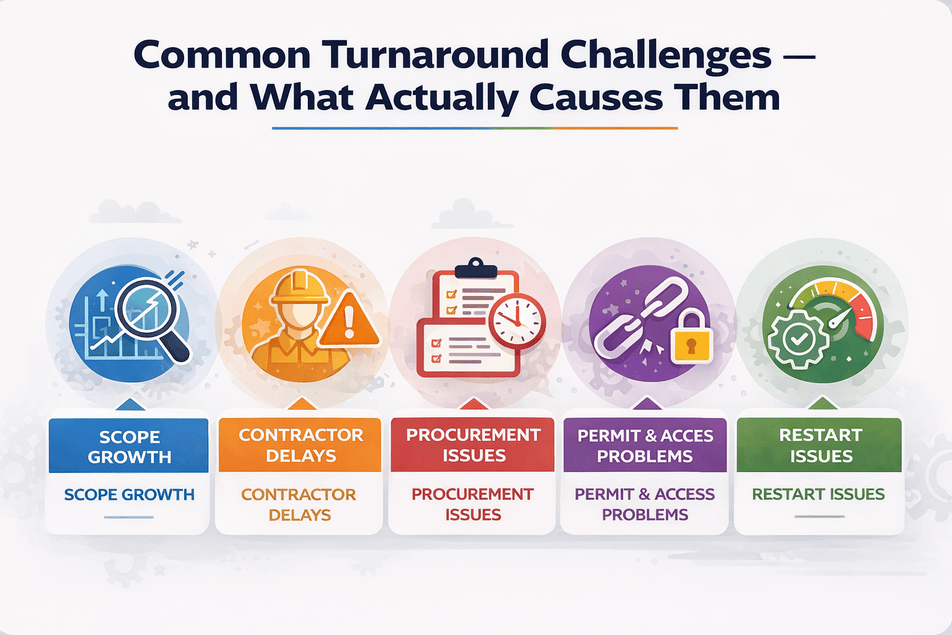
Most of the pain points in turnaround execution are predictable. They’re not inevitable, but they’re common enough that experienced planners treat them as baseline risks rather than surprises.
Scope growth mid-execution happens when inspection reveals conditions significantly worse than predicted — or when stakeholders add work after freeze without going through formal change control. Both are preventable, one through better inspection data, the other through governance discipline.
Contractor delays often trace back to poor resource leveling in the schedule — crews waiting for access, permits held up, or preceding work running over. Coordination tools that give crews live permit status and access windows reduce idle time significantly.
Procurement bottlenecks almost always originate in planning, not execution. By the time the scaffold is up and a repair scope is confirmed, there’s no good time to discover the replacement part is on a six-week lead. Early engagement between planning teams and inventory management closes this gap.
Poor restart performance — unit coming up slower than projected, or experiencing early failures — often reflects gaps in close-out documentation or testing protocols. When return-to-service sign-offs are treated as paperwork rather than verification, problems that should have been caught in the building phase show up in the first week of operation.
Turnaround Planning Best Practices That Hold Up Over Time
There’s no shortage of frameworks, methodologies, and vendor-sponsored guides on this topic. What actually separates the organizations that execute shutdowns well — year after year, across different sites — comes down to a few consistent behaviors.
Start earlier than feels necessary. The temptation to wait for more information before committing to scope is understandable, but it’s a false economy. Earlier planning creates more time to source materials, qualify contractors, and build schedule contingency before the window opens.
Protect scope freeze like a budget line. Changes after scope freeze are almost always more expensive than they appear at first glance because of their downstream effects on schedule, labor, and materials. A formal change control process with cost and schedule impact assessment for every addition is not bureaucratic friction — it’s financial protection.
Connect reliability data to planning decisions. Maintenance teams with access to vibration analysis, thickness measurement trends, and corrosion monitoring data make better scope decisions. Organizations that invest in project management services that integrate predictive data into planning workflows see measurably better outcomes over successive turnaround cycles.
Conduct a real lessons-learned review. Not a meeting where everyone agrees it went mostly fine. A structured review that captures what caused overruns, what surprised the team, and what would be done differently — and then feeds that information into the next event’s planning process. The organizations that improve most consistently treat every turnaround as data for the next one.
For a broader look at why structured planning and the right platform partner matter, explore why clients choose EzTrak for industrial turnaround management.
Frequently Asked Questions
A turnaround is a scheduled plant shutdown that allows maintenance teams to inspect, repair, and upgrade equipment that cannot be accessed during live operations. In refining and petrochemical environments, these events are often planned years in advance and involve hundreds of concurrent work activities.
Duration varies significantly by scope and unit complexity. A focused single-unit turnaround might complete in two to three weeks. A full-plant shutdown spanning multiple process units can run four to eight weeks or longer. Schedule discipline and scope control are the primary variables within a facility's control.
STO stands for Shutdown, Turnaround, and Outage — a collective term used across refining, chemical, and utilities sectors to describe planned production halts for maintenance. The STO planning process covers everything from initial scope development through final return-to-service documentation.
Facilities use a combination of scheduling tools (Primavera, MS Project), work management systems, and integrated platforms like EzTrak's turnaround planning software that consolidate scope, contractor qualification, inventory, project controls, and safety compliance in a single environment.
Turnarounds bring in large numbers of external contractors in a compressed timeframe. Verifying certifications, safety training, and compliance documentation before mobilization — through a structured contractor qualification system — reduces both safety risk and regulatory exposure. It also prevents the costly scenario of discovering qualification gaps after crews have already arrived onsite.
RBI is a methodology that prioritizes inspection activities based on the probability and consequence of equipment failure. Guided by standards such as API 510, 570, and 653, RBI helps inspection teams concentrate resources on the equipment where failure would carry the highest safety or operational impact.